
In 2006, a few years after we arrived in Manhattan and were still reeling from big city rents, The New York Times reported that a certain Mr. Freeman, mostly out of curiosity, posted an ad for renting a hole in a wall in his apartment – $35.00 a month. He had a dozen inquiries by day’s end. Home is, after all, where you hang your hat.
In the case of life on earth, home is where eventually at least one of your children can hang her hat, which means, by extension, it is where at least one of your children’s children can hang their hat, and so on. It hardly matters if it’s a hole in the wall or a luxury condo, though we’d all prefer the latter, no doubt.
When it comes to hole-in-the-wall homes, the ocean’s hadal zone probably tops the charts as the worst place to live. The hadal zone is anyplace between 4 to 7 miles below the ocean’s surface. That’s roughly 6 to 11 kilometers down – deeper, as marine biologists love to point out, than Mt. Everest is high.
Deep though the hadal zone may be, it’s a tiny place; only a couple percent of the entire ocean floor that totals over 100 million square miles (multiply by 3 for kilometers). It’s a tiny area because most of the zone is made up of deep cavernous drops or oceanic trenches and while there are plenty of oceanic trenches, they don’t cover much area.
If your home is in a hole at the very bottom of the sea, you’re living in the hadal zone.
Freeman’s hole in the wall is a luxury condo compared to hadal holes at the bottom of the sea. The hadal zone doesn’t look so bad when we are treated to pictures and videos of the place, but these images are taken with custom-made cameras mounted on ruggedly engineered diving robots or by people in deep-sea submersibles that have lots of lamps for taking those images.
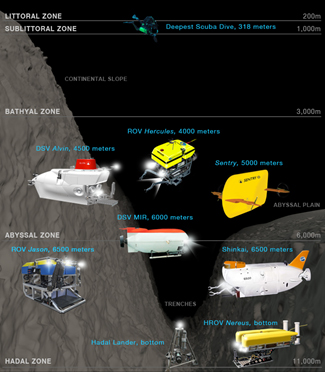
Deep sea submersibles – letting us see a word that is largely pitch black. From the HADES web site – note the hadal zone at the very bottom.
In reality, sunlight only penetrates down, at best, to maybe 660 feet (200 meters). Thus, the hadal zone is even darker than the underworld for which it is named because there is absolutely no light down there, except for the occasional flicker of bioluminescence.
It’s not just a pitch black world, it’s a creepy world – a place under a perennial drizzle of detritus, dead microbes, and particulate poop from the creatures above. Occasionally, a corpse might make it to the bottom if scavengers above missed it as it sank slowly through miles of ocean and into a trench, but that won’t happen often. It’s also near freezing and the pressure down there is a thousand times what it is up on the Earth’s surface.
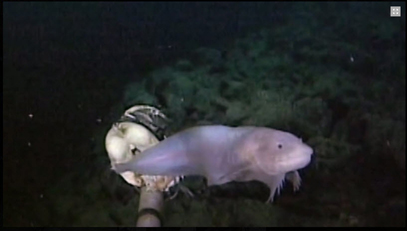
The hadal zone hardly seems a neighborhood where anything would want to live. And yet, scientists from the Hadal Ecosystem Studies program, or HADES, recently broke the record for the deepest fish ever found. So, in spite of what must be the most extreme conditions on Earth, there are creatures that call it home.
But when you think about it, though the hadal zone is pretty extreme, the truth is, much of the world is inhospitable – too hot or cold, too dry or wet, and/or too little food or energy to go around. Of the 330 million cubic miles (about 1,200 million cubic kilometers) of ocean water, only 14 cubic miles (or just 60 cubic kilometers) is in the sunlit or euphotic zone. The euphotic zone is what we think of when we think of the ocean – kelp beds, coral reefs, eel-grass beds, or the surface waters where we see jellyfish, sun sharks, and sea turtles, but the vast majority of the ocean is a dark, cold place. The same is true for terrestrial Earth – we tend to think of majestic forests filled with trees, flowering plants, buzzing insects, and a host of birds and mammals, or we might think of grasslands with elk and bison and wildflowers everywhere. But vast regions of terrestrial Earth are dry (16%) or just rock and ice where little can live (25%). It’s hard to say what percent of land is perfect for life, but if we were to consider that to be tropical habitats – that’s only about 24% of the terrestrial world.
Yet, no matter how inhospitable a place on Earth is, whether the dark hadal zone or the icy arctic, you will almost always find species that call it home. They and their children and their children’s children, and so on, live there generation after generation.
When I think of our Biosphere, I think of New York City – home to millions. It’s not the few who live in mansions, townhouses, luxury condos, or spacious, well-furnished, well-lit abodes that make NYC the vibrant city it is, though the wealthy often serve some important roles. It’s the writers, musicians, artists, short-order cooks, police, firefighters, medics, teachers, scientists, architects, engineers, students, bus drivers, train conductors, garbage collectors, and the millions of people who live and work together that make the city work. Their homes are modest places, though holes in the wall are probably rare.
The Biosphere is the same as vibrant mega-cities – all its inhabitants live and work in every space imaginable. The hadal zone is no luxury abode, but it’s home to hundreds of species, two thirds of them living nowhere else, and if we could figure out how to estimate how many archaeal and bacterial species live down there, the number would be much bigger. It’s not just weird fish (including eels) down there, but amphipods, crabs, isopods, sea cucumbers, mollusks, lots of microorganisms, and probably many species waiting to be found. The hadal zone may be ecological holes in the wall, but then most of Earth is a challenging place for life. Yet, 8.7 million species call it home, and make for a rich and vibrant world.
Life values every place on Earth as home. Strange that not all of us value Earth in the same way given that we too make our homes here.
 shahidnaeemblog