
Masters of the Biosphere
We humans are incredibly fortunate here on earth because each of us has about 19,290 bioslaves in human-equivalent terms, to take care of us.
One might ask what a bioslave in human equivalents is – it sounds cool, though maybe creepy. In the modern world, to be a slave master is an ugly, horrible thing. But maybe being a master of bioslaves is different?
So let’s start by taking a closer look at bioslaves.
Bioslaves
One of the most important, fun, and possibly incredibly deeply disturbing ways of understanding humanity is to understand the unavoidable fact that we are Masters of the Biosphere.
Protest all you want, and champion the bacteria or lions or something else you think are the true Masters of the Biosphere, but there is simply no getting around the fact that, for better or worse, we totally dominate the Biosphere. Sorry, but we 7.2 billion people rule – we command most of Earth’s freshwater, have converted almost all of the most productive lands to agricultural systems, have move more earth than Earth itself, and have radically altered Earth’s atmosphere, biosphere, lithosphere and hydrosphere – a lot of spheres, and no other species can make such a claim.
If we are masters, than all other species are slaves – bioslaves, to be precise.
You could think of non-human species as our friends, family, or fellow citizens of the Biosphere rather than our slaves, but that’s not popular thinking. Most people think of plants, non-human animals, and microorganisms as soulless creatures here to serve us. Indeed, the most popular environmental trend right now is to think that all non-human life is here to do one thing and one thing only – to serve us. Modern environmentalism is mostly about ecosystem services – saving nature because it serves us. But let’s not get caught up in that debate.
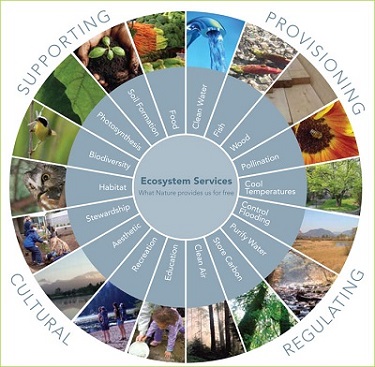
The dominant theme in modern environmentalism is the idea of ecosystem services – nature’s value is in its service to us and not much else matters.
What is lost by this view is that we don’t get through life on our own – our air is manufactured by plants, animals and microorganisms that also purify our water, produce our fruits, nuts, mushrooms, lumber, fiber, feed for our domestic animals, and medicines. They regulate our climate, curtail the spread of disease, pollinate where pollination is necessary, and do a million, million things we totally love having done for us.
Picture yourself in brilliant white linen clothes, recumbent on a splendid chaise lounge, sipping bourbon (with an ice ball) on the veranda of an enormous mansion, many times bigger than you could possibly need, and you’re surrounded by creatures that do everything for you. Then, consider the extraordinary thing that you don’t pay them anything for it. And if you don’t like them, you can burn, poison, incarcerate, sell, or kill them. Really, you are the master and they the slaves. Thinking like the slaveholders and traders of yore, we just have to claim that plants, animals and microorganisms have no souls and according to convenient interpretations of otherwise inscrutable biblical texts, they are here to serve us by God’s will.
I know, I know, that’s a horrible way to think of the living world, but just for the moment, imagine it’s the God’s truth. We can buy, trade, torture, murder, or drive to extinction any species and do whatever we want so that we can have rich and fulfilling lives. OK – maybe so only 1% can have rich and fulfilling lives, but that’s another subject.
Now that we have a sense of what a bioslave is, we have to convert them into human slaves to get a better grip on what all this means.
Bioslaves and the Human Convertitron
The question that immediately comes to mind is – how many slaves do we each have in terms we can understand?
Scientists do this weird thing called back-of-the-envelope-calculations (BOTEC)) to quickly gain insights into things that are very difficult to fathom. Here’s my BOTEC:
- We currently are 7.2 billion people each weighing, on average, 40 kilograms (remember that a kilo is about 2 pounds). Some are babies and weigh only a little while some are very, very heavy, so, I’m saying your average human weighs about 40 kilos.
- Take an average human – spleen, blood, liver, skin, bones, brain, fat, and put it all in a blender – whrrrrrrrrrrr!
- Extract the carbon – the key element to organic life. Humans are about 18% carbon. So, the yield would be 7.2 kilograms of carbon per average human.
- So now, in our BOTEC, we have to imagine this machine called the Human Convertitron. It’s like the Matter Replicator in the Star Trek science fiction TV shows where as a member of the Federation we can type g-l-a-s-s-o-f-w-i-n-e-a-n-d-p-l-a-t-e-o-f-c-h-e-e-s-e into the console of a Matter Replicator and, after a very brief time, wine and cheese, complete with glass and plate, appear. Presumably it took other matter and converted it into what we wanted. The Human Convertitron is even simpler – it converts all matter into humans. It’s basically the technological equivalent of a pronatalist agenda – but that too, is another subject.
- Now take all the bustards, hawks, hummingbirds, pigeons, sea gulls, sparrows, otters, clouded leopards, elephants, mushrooms, bacteria in all the soils, sediments, and microbiomes of all creatures on earth, and all the redwoods, orchids, oaks, grasses, legumes, daisies, lianas, ferns, palms, lichens, dung beetles, dragonflies, aphids, butterflies, tuna, shark, crabs, lobsters, shrimp, snails, limpets, clams, oysters, mussels, chaetognaths, priapulids, corals, worms, and so on, and put it all in a blender – whirrrrrrrrrrrr!
- Feed this biosphere blend into the Human Convertitron and out pops, if I did my math right, 140 trillion humans! (My logic: there are a trillion metric tons of carbon in the biosphere which, if you divide by 7.2 kilos per person, gets you 140 trillion humans).
- One more bit of simple math – take the 140 trillion human slaves and divide them by 7.2 billion and that means we each have about 19,290 slaves each.
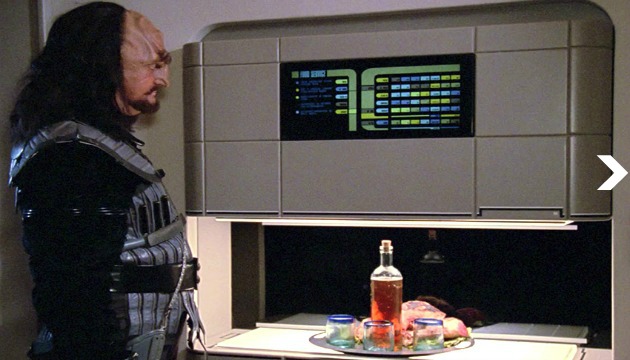
The Matter Replicator in Star Trek science fiction converts matter into whatever you want. The Human Convertitron is the same hypothetical machine, only it converts matter into humans.
It might be mildly disquieting to consider that we each have 19,290 slaves working for us. Imagine waking in the middle of the night and discovering 19,290 slaves standing in the dark, packed into your room, spilling out into the streets, all waiting to serve you.
On the other hand, it’s a stunning thing to consider the extraordinary magnitude to which we are served by nature when we convert biodiversity to humans.
What nature does for us is equivalent to having 19,290 human slaves working for us 24/7 without any compensation, rights, or protection of their well-being.
It’s a good thing we don’t have a Human Convertitron because if we did and if we converted all life to humans, Earth would collapse almost instantly unless the 140 trillion humans knew how to make our environment habitable so that we and the other 7.2 billion (or that portion of legal age) can sip bourbon (with ice balls).
On the other hand, maybe if we saw ourselves as part of the community of life on Earth, rather than Masters of the Biosphere, things might play out differently. Slavery is one of the darkest sides of human nature and while we may not see its ugliness in the concept of bioslaves, when we recast our biota into the equivalent of human slaves, an exercise meant to see nature differently, we discover how deeply disturbing it is to consider life on Earth our slave. Perhaps if we had considered ourselves working in league with species, rather being masters of the Biosphere, we would view life on Earth in a way that would promote environmental sustainability and human wellbeing.
————————————————————————————————————————–
*Over the years, in foolish anticipation of one day writing a book entitled, Notes from an Increasingly Lonely Planet, I started collecting thoughts about the demise of our world that might convey ecology and evolution in unconventional, perhaps more interesting and even entertaining ways. I worried that the bulk of environmental literature, especially books, prophesized doom, were alarmist, chastised their readers or humanity in general, or were otherwise off-putting. I understand where environmental writers are coming from, but I wanted to take a different approach, even if the message might have unavoidably somber overtones. These notes, however, just don’t come together well as a book, so I hope they might work as blogs.
This is my first installment of Notes in my year of practice blogging.
 shahidnaeemblog