

It’s hard to remember everything.
A study came out that says chocolate improves memory!
Well, not exactly.
I bought a sack of “fun”-size Mars Bars because their on sale this time of year – post Halloween and all. Not sure where I put them. I think I got them at Target. Or maybe I’m not supposed to shop there? Or was it Walmart I’m not supposed to shop at? Doesn’t Walmart help to preserve one acre of wildlife area for every acre it converts to megastores? “Acres for America,” or some such program – I think they’ve helped preserve 690,000 acres. But then, that must mean they converted 690,000 acres of land to stores, no? I think they were going to convert 88,000 hectares of pine rockland, an endangered habitat in Florida, to a store. Cannot, for the life of me, remember if I’m supposed to shop there or not.
Doesn’t seem like I should support something that destroys endangered habitat if I care about the environment. And I do. As an ecologist, I think about my actions and try to help protect and preserve our living world. But it’s hard to keep all these facts in mind. Especially when we have to worry about Ebola, which made it here in New York City, or all those horrific kidnappings in Nigeria by Boko Haram. What a scary world! Who needs Halloween?
But if there wasn’t Halloween, there wouldn’t be chocolates on sale after the holiday.
What was it I was writing about?
Oh yes! Chocolate, memory…right…got it.
It’s interesting that this study, supported by the Mars chocolate company, found that a specially prepared drink high in chocolate-derived flavonols, organic compounds found in chocolate and other foods, improved a specific kind of memory. It’s interesting because cocoa processing apparently often destroys flavonols, which is why the Mars company had to specially prepare the drink for the researchers since, most likely, any of its 29 brands of chocolate, like M&Ms, Mars Bars, and Snickers, wouldn’t have enough of the stuff to be useful for a clinical trial.

Mars truck.
I’ll bet the media will have a blast with this finding!
I love the stuff. Chocolate. I got a lot for my birthday, though I thought as one gets older one’s love of sweets declines, if I remember correctly. Not with me. I love the stuff even though I’m getting old!
I also seem to recall that 70% of chocolate is grown by smallholder farmers in developing countries in biodiversity rich areas like Cote d’Ivoire, Ghana, Cameroon, Indonesia, Malaysia, Papua New Guinea, Brazil, Ecuador, Colombia, and NIgeria. I’ve been to a bunch of these places, although I don’ think I’ve been to Papua New Guinea. I’ll have to look through my 35 mm photographic slides, though I don’t have a slide projector any more – I keep forgetting that I’ve got to get around to converting those things to pics.

Birds and cocoa plantations, Costa Rica, studied by CATIE.
Guinea has Ebola. But that’s not Papua New Guinea. Phew!
Wait, I’ve not been to either place. So, no worries. Double phew!
Stunning biodiversity in all these cocoa-growing countries, however! Millions of species of plants and animals and beneficial microorganisms. Beautiful people! Agro-forestry areas are so much nicer than plantations and pastures or worse, cornfields. But I think child labor happens in some cocoa production areas and there’s a lot of violent conflict, poverty, malnutrition, and disease in some of these places. Boko Haram, Ebola … it’s in New York now (I already mentioned that, right?), Ebola that is, not Boko Haram (at least so far as we know – this is a diverse city). They’re in Nigeria – Boko Haram (not Ebola, so far as we know, but it’s a biodiverse country so the disease could be there).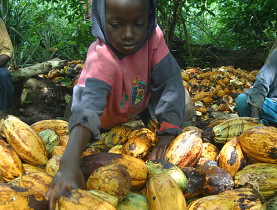
Shade-grown chocolate, I hear, isn’t so bad, in terms of agriculture, however, which I suppose is some sort of consolation. Maybe I should look for shade-grown, fair-trade, and organic stickers on Mars products – must be somewhere on the package. I mean, the company has a net worth of something like five billion dollars. (Did I already say that?) It would be awesome if they were fair-trade and sustainably-grown.
And it’s better for climate change, agroforestry that is, as opposed to fertilizer and pesticide drenched cocoa plantations. That’s what my student, Vivian, who studies coffee agroforestry in Chiapas, says. Coffee’s another issue. I also love that stuff too, coffee, and mocha is the best, a mix of both coffee and chocolate – excellent!
Some say that growing a pound of corn on a fertilizer and pesticide drenched cropland releases a pound of carbon into the atmosphere. That’s terrible for global warming!
A pound of chocolate releases about a third of a pound of carbon into the atmosphere – so that’s better, right? – well… still bad, but better.
So what about Cocoa Puffs – corn puffs with chocolate?
There’s something like 5 – 6 million cocoa farmers worldwide and something like 40-50 million people whose livelihoods depend on cocoa. If one combines coffee, cocoa, oil palm, and other agroforestry systems, I think 43% of Earth’s agricultural land is agroforestry, something totaling to around 2.5 billion acres with some 900 million people living in these landscapes. Agroforestry is particularly prevalent in Southeast Asia, Central America, and South America with over 50% of area under agroforestry. There’s lots in Sub-Saharan African tropical countries too, like Nigeria.
Funny, only about ten million acres of forest are protected (sort of) worldwide. Not so funny, I guess – but I can never remember numbers. Seems sort of miniscule – what’s protected versus what we turn into mochas.
Oh, here’re my chocolates! Right where I left them, after all that scattered thinking about forests, biodiversity, people, agriculture, carbon in the atmosphere and global warming, Ebola and Boko Haram.
Hope these chocolates can help my memory so I don’t forget all this stuff.
Now, where’s my coffee?
 shahidnaeemblog