biodiversity, conservation, environment

Notes from an Increasingly Lonely Planet* 1: Bioslaves and the Human Convertitron

Masters of the Biosphere

We humans are incredibly fortunate here on earth because each of us has about 19,290 bioslaves in human-equivalent terms, to take care of us.

One might ask what a bioslave in human equivalents is – it sounds cool, though maybe creepy.  In the modern world, to be a slave master is an ugly, horrible thing.  But maybe being a master of bioslaves is different?

So let’s start by taking a closer look at bioslaves.

Bioslaves

One of the most important, fun, and possibly incredibly deeply disturbing ways of understanding humanity is to understand the unavoidable fact that we are Masters of the Biosphere.

Protest all you want, and champion the bacteria or lions or something else you think are the true Masters of the Biosphere, but there is simply no getting around the fact that, for better or worse, we totally dominate the Biosphere.  Sorry, but we 7.2 billion people rule – we command most of Earth’s freshwater, have converted almost all of the most productive lands to agricultural systems, have move more earth than Earth itself, and have radically altered Earth’s atmosphere, biosphere, lithosphere and hydrosphere – a lot of spheres, and no other species can make such a claim.

If we are masters, than all other species are slaves – bioslaves, to be precise.

You could think of non-human species as our friends, family, or fellow citizens of the Biosphere rather than our slaves, but that’s not popular thinking.  Most people think of plants, non-human animals, and microorganisms as soulless creatures here to serve us.  Indeed, the most popular environmental trend right now is to think that all non-human life is here to do one thing and one thing only – to serve us.  Modern environmentalism is mostly about ecosystem services – saving nature because it serves us.  But let’s not get caught up in that debate.
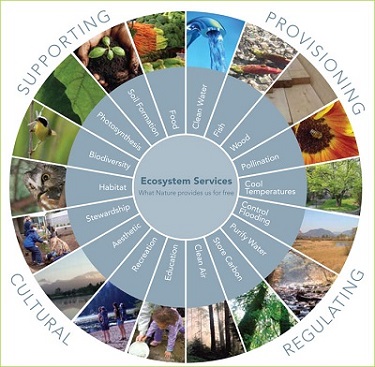
The dominant theme in modern environmentalism is the idea of ecosystem services - nature's value is in its service to us and not much else matters.

The dominant theme in modern environmentalism is the idea of ecosystem services – nature’s value is in its service to us and not much else matters.

What is lost by this view is that we don’t get through life on our own – our air is manufactured by plants, animals and microorganisms that also purify our water, produce our fruits, nuts, mushrooms, lumber, fiber, feed for our domestic animals, and medicines.  They regulate our climate, curtail the spread of disease, pollinate where pollination is necessary, and do a million, million things we totally love having done for us.

Picture yourself in brilliant white linen clothes, recumbent on a splendid chaise lounge, sipping bourbon (with an ice ball) on the veranda of an enormous mansion, many times bigger than you could possibly need, and you’re surrounded by creatures that do everything for you.  Then, consider the extraordinary thing that you don’t pay them anything for it.   And if you don’t like them, you can burn, poison, incarcerate, sell, or kill them.  Really, you are the master and they the slaves.  Thinking like the slaveholders and traders of yore, we just have to claim that plants, animals and microorganisms have no souls and according to convenient interpretations of otherwise inscrutable biblical texts, they are here to serve us by God’s will.

I know, I know, that’s a horrible way to think of the living world, but just for the moment, imagine it’s the God’s truth.  We can buy, trade, torture, murder, or drive to extinction any species and do whatever we want so that we can have rich and fulfilling lives.  OK – maybe so only 1% can have rich and fulfilling lives, but that’s another subject.

Now that we have a sense of what a bioslave is, we have to convert them into human slaves to get a better grip on what all this means.

Bioslaves and the Human Convertitron

The question that immediately comes to mind is – how many slaves do we each have in terms we can understand?

Scientists do this weird thing called back-of-the-envelope-calculations (BOTEC)) to quickly gain insights into things that are very difficult to fathom.  Here’s my BOTEC:

  1. We currently are 7.2 billion people each weighing, on average, 40 kilograms (remember that a kilo is about 2 pounds). Some are babies and weigh only a little while some are very, very heavy, so, I’m saying your average human weighs about 40 kilos.
  2. Take an average human – spleen, blood, liver, skin, bones, brain, fat, and put it all in a blender – whrrrrrrrrrrr!
  3. Extract the carbon – the key element to organic life. Humans are about 18% carbon.  So, the yield would be 7.2 kilograms of carbon per average human.
  4. So now, in our BOTEC, we have to imagine this machine called the Human Convertitron. It’s like the Matter Replicator in the Star Trek science fiction TV shows where as a member of the Federation we can type g-l-a-s-s-o-f-w-i-n-e-a-n-d-p-l-a-t-e-o-f-c-h-e-e-s-e into the console of a Matter Replicator and, after a very brief time, wine and cheese, complete with glass and plate, appear.  Presumably it took other matter and converted it into what we wanted.  The Human Convertitron is even simpler – it converts all matter into humans.  It’s basically the technological equivalent of a pronatalist  agenda – but that too, is another subject.
  5. Now take all the bustards, hawks, hummingbirds, pigeons, sea gulls, sparrows, otters, clouded leopards, elephants, mushrooms, bacteria in all the soils, sediments, and microbiomes of all creatures on earth, and all the redwoods, orchids, oaks, grasses, legumes, daisies, lianas, ferns, palms, lichens, dung beetles, dragonflies, aphids, butterflies, tuna, shark, crabs, lobsters, shrimp, snails, limpets, clams, oysters, mussels, chaetognaths, priapulids, corals, worms, and so on, and put it all in a blender – whirrrrrrrrrrrr!
  6. Feed this biosphere blend into the Human Convertitron and out pops, if I did my math right, 140 trillion humans! (My logic:  there are a trillion metric tons of carbon in the biosphere which, if you divide by 7.2 kilos per person, gets you 140 trillion humans).
  7. One more bit of simple math – take the 140 trillion human slaves and divide them by 7.2 billion and that means we each have about 19,290 slaves each.

The Matter Replicator in Star Trek science fiction converts matter into whatever you want.  The Human Convertitron is the same hypothetical machine, only it converts matter into humans.

The Matter Replicator in Star Trek science fiction converts matter into whatever you want. The Human Convertitron is the same hypothetical machine, only it converts matter into humans.

It might be mildly disquieting to consider that we each have 19,290 slaves working for us.  Imagine waking in the middle of the night and discovering 19,290 slaves standing in the dark, packed into your room, spilling out into the streets, all waiting to serve you.

On the other hand, it’s a stunning thing to consider the extraordinary magnitude to which we are served by nature when we convert biodiversity to humans.

What nature does for us is equivalent to having 19,290 human slaves working for us 24/7 without any compensation, rights, or protection of their well-being.

It’s a good thing we don’t have a Human Convertitron because if we did and if we converted all life to humans, Earth would collapse almost instantly unless the 140 trillion humans knew how to make our environment habitable so that we and the other 7.2 billion (or that portion of legal age) can sip bourbon (with ice balls).

On the other hand, maybe if we saw ourselves as part of the community of life on Earth, rather than Masters of the Biosphere, things might play out differently.  Slavery is one of the darkest sides of human nature and while we may not see its ugliness in the concept of bioslaves, when we recast our biota into the equivalent of human slaves, an exercise meant to see nature differently, we discover how deeply disturbing it is to consider life on Earth our slave.  Perhaps if we had considered ourselves working in league with species, rather being masters of the Biosphere, we would view life on Earth in a way that would promote environmental sustainability and human wellbeing.

————————————————————————————————————————–

*Over the years, in foolish anticipation of one day writing a book entitled, Notes from an Increasingly Lonely Planet, I started collecting thoughts about the demise of our world that might convey ecology and evolution in unconventional, perhaps more interesting and even entertaining ways.  I worried that the bulk of environmental literature, especially books, prophesized doom, were alarmist, chastised their readers or humanity in general, or were otherwise off-putting.  I understand where environmental writers are coming from, but I wanted to take a different approach, even if the message might have unavoidably somber overtones.  These notes, however, just don’t come together well as a book, so I hope they might work as blogs.

This is my first installment of Notes in my year of practice blogging.

Standard
Uncategorized

Bustards, Beetles, and Viagra

My spouse told me that a Saudi prince, with a huge, expensively kitted out entourage, went to Balochistan, Pakistan not long ago and killed 2,100 endangered houbara bustards – 2,000 more than his permit allowed.  The web was filled with shock and outrage, in part because many believed that this beautiful bird, on the verge of extinction, was killed because they are considered by some to be aphrodisiacs.  “Is there any more ridiculous reason to kill an animal?” asked Naeem Sadiq, a Pakistani activist with a name uncannily similar to mine.

Posted widely on the web, a picture of a bustard hunting - the modern way.

Posted widely on the web, a picture of bustard hunting – the modern way.

That’s a great question!  The answer is easy when you consider stimulants, experiencing a romantic evening, blister beetles, and penile erection.

OK – let’s start with stimulants.

Stimulants are amazing!  When an electrical impulse triggers a neuron to fire, it releases a chemical message to other cells.  The chemical signal, however, has to leap across a gap to get to the other cells.  This gap, or synapse, is the slimmest of spaces imaginable – it’s roughly 30 nanometers across or about one three thousandth the thickness of a sheet of paper.  Yet it’s in this impossibly small space that stimulants, like coffee and crack cocaine, slip in and mess with nerve signals.  This means that when the brain processes all the signals it gets from the surrounding world (sights, sounds, smells and so forth) and creates what we experience, stimulants can alter that experience even though the surrounding world hasn’t changed.

Consider the experience of a romantic evening.  If the sights of an attractive partner, the warmth of a crackling fire, the sounds of Nat King Cole on a muted MP3 player, and a complex milieu of culturally and socially tuned behaviors all align themselves just right, one might experience a romantic evening … which can mean sex, which, if at least one guy is involved, often means an erect penis.  I know that’s rather unromantic, but that aside, suffice it to say that romance and erect penises are not necessarily easy things to engineer.  Stimulants, at least in theory, can change this.  Add to the mix of evening activities imbibing alcohol, eating oysters, chocolates, ginseng, the testicle of a bull, snake meat, bark of the yohimbe tree, Brazilian potency wood, MACA root, the penis of a tiger or dog, eating penis- or vagina-shaped mushrooms sautéed in butter, ground horn of a rhino, the meat of a pangolin or gecko, and possibly hundreds of other stimulants, and the experience is altered even though the surrounding world was not – same partner, same crackling fire, same music, different experience.

Now, enter the blister beetle and the bustard.

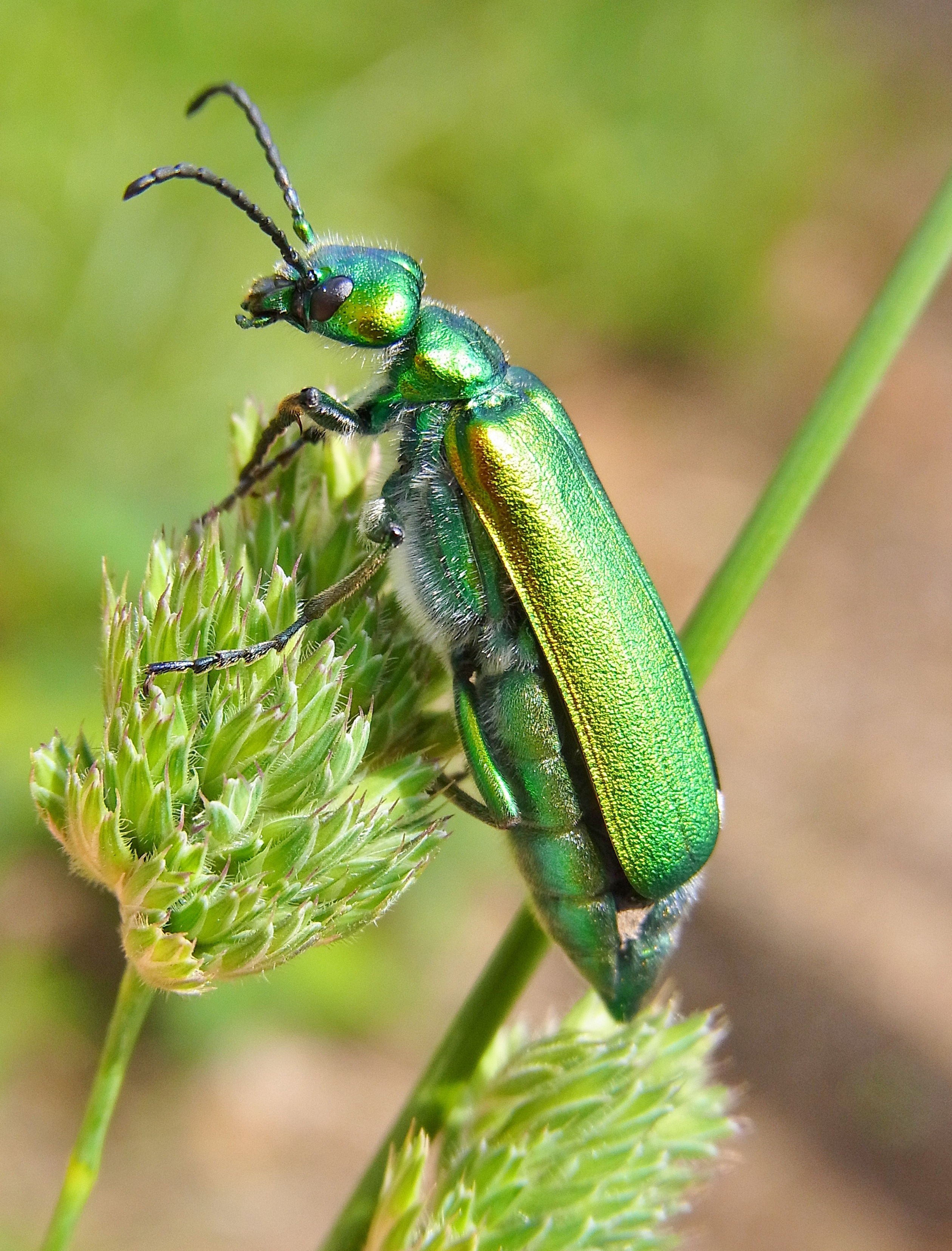
The Spanish fly is actually a blister beetle ( Lytta vesicatoria) whose noxious defensive chemical is toxic to people and bustards, but its toxin, cantharidin, in small amounts, is believed to be an aphrodisiac.

The Spanish fly is actually a blister beetle ( Lytta vesicatoria) whose noxious defensive chemical is toxic to people and bustards, but its toxin, cantharidin, in small amounts, is believed to be an aphrodisiac.

Blister beetles are famous for blasting attackers with cantharadin – a toxin strong enough to cause blisters on contact and to kill if ingested. Weirdly, blister beetles are believed to be aphrodisiacs, commonly known as “Spanish flies,” even though they obviously are not flies.  The way it works is that a sub-lethal dose of cantharadin induces vascular inflammation of the genitourinary tract in men and women – it’s hard to imagine inflamed penises and vaginas as romantic.

So all this got me to thinking.  In October, Carolina Bravo and colleagues published in PloS One, a leading scientific journal, a study suggesting that great bustards eat just enough blister beetles to ward off gut infections and parasitic worms.  They also noticed that males eat more blister beetles than females and that females check out the anus of males during courting, which is where you’d look (if you were a female bustard or, in this case, a scientist) to see if there were worms or any signs of a poorly functioning gut.  The authors suggest, though they really didn’t prove it, that male bustards eat extra blister beetles to self-medicate and show their healthiness so when a female comes to check their anus out – bingo!

So here’s my completely unsubstantiated scientific hypothesis – maybe the houbara bustard, like the great bustard, also eats blister beetles and that’s why it supposedly has aphrodisiac-like properties.  It’s much safer to eat a bustard that ate blister beetles than it is to eat blister beetles.  And while inflammatory irritation of the penis and vagina is not exactly romantic, death certainly wrecks a romantic evening.

The Prince, however, most likely claims that they are not aphrodisiac seekers.  Rather, they are falconers like their nomadic ancestors, the Bedu, who would capture falcons, hunt bustards to supplement their meager diets, and then release the falcons and move on.

Now we can answer Sadiq’s question.

Yes, killing bustards to allegedly keep a tradition alive is more ridiculous.  According to one account, the Prince and entourage fly in on private jets, have roads and luxurious accommodations built, bribe government officials to kill vastly more birds than they are permitted, enjoy lavish meals, satellite telephones and wi-fi, and drive luxury SUVs.  This is not keeping the Bedu tradition of falconry alive.  It is simply indulgent, repugnant “sport”.

That’s not to say that killing bustards for their aphrodisiacal properties isn’t ridiculous. It’s just a tiny bit less ridiculous.

Standard
Uncategorized

Horses and Insurgents

I came across this recent paper published in Nature Communications on the Cambaytheres, a group of mammals I have to confess I had not heard of before, but the article made me think about horses and insurgents.

In the paper, Kenneth Rose and his co-authors claim that 50 million-year-old fossils found in an old mine in Gujarat, India tell us that horses, rhinos, and tapirs, or the Perissodactyla, originated in India.  What’s interesting is that 50 million years ago, India was an island, adrift at sea, heading for a horrific, slow crash with Eurasia.

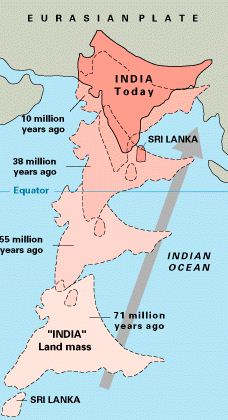
India adrift.   Cruising from the south after her split up with Africa and Australia and her abandonment of Madagascar, she crashed into Eurasia. The mountains to the north are the crumpled regions of the crash.  Part of her western region is known as Pakistan.

India adrift. Cruising from the south after her split up with Africa and Australia and her abandonment of Madagascar, she crashed into Eurasia. The mountains to the north are the crumpled regions of the crash. Part of her western region is known as Pakistan.

It’s hard to fathom – but India began as a massive chunk of land squeezed between Africa and Australia in the Southern Hemisphere a half a billion years ago.  She broke free and fled across the sea, leaving Madagascar behind but taking Sri Lanka with her until she crashed violently into Asia – the Himalayan mountain range is like massive, rumpled bumper of the crash.

When I close my eyes, I see India cruising at top speed across the ocean, breaking waves, leaving a huge wake, but, of course, the actual trip took a couple hundred million years, so I doubt any of the creatures on board noticed or felt even mildly seasick.

What Rose and his colleagues tell us is that some of the creatures on board were the evolutionary ancestors of the Perissodactyla.  The fossils they examined are bones of Cambaytherium species, mammals from the Indo-Pakistan region dating back to the Eocene, some 56 to 33 million years ago.  Since the Cambaytherium share a common ancestor with the Perissodactyla, and India was an island at the time, the evolutionary roots of horses, rhinos, and tapirs must be Indian.

It’s hard now, when looking at the horses in Central Park or the police horses in Times Square, to not want to go up and ask them what it’s like to be of Indian ancestry – I always felt a kinship with them, as I do with all creatures, but now I feel a little closer.  My bacterial cousins go back 3.5 billion years, but my horse cousins go back a mere 50 million years – that practically makes them siblings rather than cousins.

I’ve been to Gujarat.  My student, Meha Jain, worked in Gujarat, so I went to see her doing her dissertation work.  I had a fantastic time during my visit.  I didn’t have time to go see the last remaining population of the endangered Asiatic Lion and the endangered Asiatic Wild Ass that reside in reserves in Gujarat.  When I travel, I try to visit nature, but there wasn’t time and the reserves were far away.  The rural farmscape, however, though devoid of natural habitat, had a beauty of its own.

Like many, of course, I knew Gujarat for the 2002 massacre of hundreds of Muslims and the displacement of thousands more.  A center for Hindu nationalism, a violent history, and the complicity of its Governor, Narendra Modi, in the violence, seemed contrary to its warm and gracious people and its intricate culture.  In spite of Modi’s dubious past, he was immensely popular in Gujarat, his portrait was everywhere, and today, he is India’s Prime Minister.  When he visited here in late September, he was greeted as if he were some sort of hero – at Madison Square Garden, an audience of 19,000 cheered.

When I think of Gujarat, I think of India and about its extraordinary geological and biological history that generated amazing natural wealth – some of the most unique and diverse flora and fauna in the world are found in India.  When we, by which I mean our species, arrived in India, out of Africa and on our way to South East Asia and eventually to Australia and New Zealand, many of us must have stayed in places that must have seemed like the fictional Shangri La.

Out of Africa and into India happened only 50 to 70 thousand years ago, yet, in that short time, and particularly in the last 100 years of colonialism and postcolonialism, we have spent down the natural wealth of the region.  With the spending down of that natural capital, as economists call it, to make built capital, another economics term, we now have farms that barely support their people and cities that lack the resources to provide the kind of infrastructure necessary to make urban environments work well for many.  Some 270 million people live in poverty in India – how did that happen?

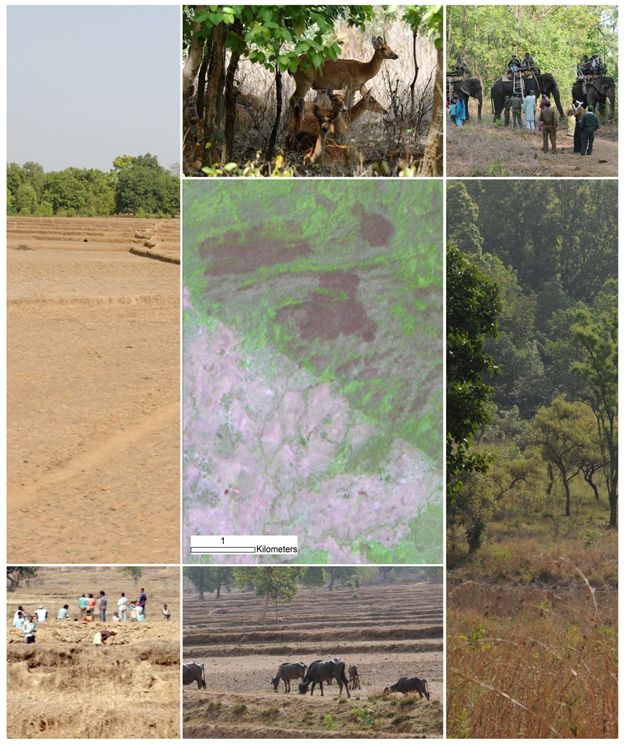
Then (50 thousand years ago) and now.  The center shows a satellite image of Khana National Park (green area above the diagonal which is the park boundary) vs. agricultural transformation (whitish areas left of the boundary).   Pictures on top and left are from the park, while pictures on the bottom and right are of the surrounding landscape.  I took all these pictures on a single day in August, 2009 and the figure was published in an article. Naeem, S. and R. DeFries. 2009. La conservation des espèces, clé d'une adaptation climatique durable., Institut du développement durable et des relations internationals. Sciences Po., Paris, France.

Then (50 thousand years ago) and now. The center shows a satellite image of Khana National Park (green area above the diagonal which is the park boundary) vs. agricultural transformation (whitish areas left of the boundary). Pictures on top and left are from the park, while pictures on the bottom and right are of the surrounding landscape. I took all these pictures on a single day in August, 2009 and the figure was published in an article.
Naeem, S. and R. DeFries. 2009. La conservation des espèces, clé d’une adaptation climatique durable., Institut du développement durable et des relations internationals. Sciences Po., Paris, France.

I’m not a political scientist and have no particular authority on social or humanist matters, but it seems to me that the end result of the loss of nature’s capital is a rise in insurgency.  In the general region, Sunni insurgents attack Iran, the Jaish-e-Mohammed, Harakat ul-Mujahidin and Lashkar-e Tayyiba fighters fight with the Pakistani government, the Taliban attack Afghanis, Sikh insurgents in Punjab attack their fellow citizens as do Naxalite Maoists in Eastern India.  In the grand scheme of things, these violent conflicts are small compared to the hundreds of millions who reside peacefully in the region, but that is cold comfort to the innocent killed or injured in the struggles.  Worse, insurgency is a source of omnipresent fear and often an obstacle to tackling other issues, such as poverty, income inequality, and environmental degradation – the very things that breed insurgency.  In the US, for example, we invest less and less in the environment, but out of fear and distraction, we have spent 2 – 5 trillion dollars on fighting insurgents since 9/11.

I know my thinking is often pretty circuitous, to say the least, but that’s what the paper by Rose and his colleagues does for me.  Now, when I see horses, I think of India and its extraordinary biogeographical history and how, in the geological blink of an eye, we transformed the very places within which we and biological diversity prospered, to landscapes that, in the absence of any ecologically sensible stewardship, lead to poverty, inequality, and the autocatalysis of insurgency.

Standard