biodiversity, conservation, environment

Notes from an Increasingly Lonely Planet* 1: Bioslaves and the Human Convertitron

Masters of the Biosphere

We humans are incredibly fortunate here on earth because each of us has about 19,290 bioslaves in human-equivalent terms, to take care of us.

One might ask what a bioslave in human equivalents is – it sounds cool, though maybe creepy.  In the modern world, to be a slave master is an ugly, horrible thing.  But maybe being a master of bioslaves is different?

So let’s start by taking a closer look at bioslaves.

Bioslaves

One of the most important, fun, and possibly incredibly deeply disturbing ways of understanding humanity is to understand the unavoidable fact that we are Masters of the Biosphere.

Protest all you want, and champion the bacteria or lions or something else you think are the true Masters of the Biosphere, but there is simply no getting around the fact that, for better or worse, we totally dominate the Biosphere.  Sorry, but we 7.2 billion people rule – we command most of Earth’s freshwater, have converted almost all of the most productive lands to agricultural systems, have move more earth than Earth itself, and have radically altered Earth’s atmosphere, biosphere, lithosphere and hydrosphere – a lot of spheres, and no other species can make such a claim.

If we are masters, than all other species are slaves – bioslaves, to be precise.

You could think of non-human species as our friends, family, or fellow citizens of the Biosphere rather than our slaves, but that’s not popular thinking.  Most people think of plants, non-human animals, and microorganisms as soulless creatures here to serve us.  Indeed, the most popular environmental trend right now is to think that all non-human life is here to do one thing and one thing only – to serve us.  Modern environmentalism is mostly about ecosystem services – saving nature because it serves us.  But let’s not get caught up in that debate.
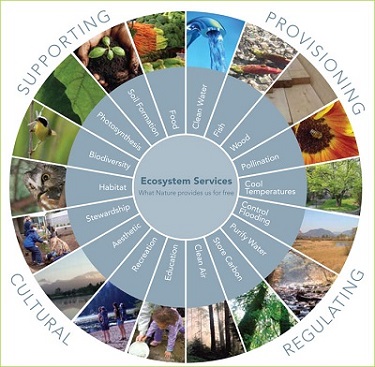
The dominant theme in modern environmentalism is the idea of ecosystem services - nature's value is in its service to us and not much else matters.

The dominant theme in modern environmentalism is the idea of ecosystem services – nature’s value is in its service to us and not much else matters.

What is lost by this view is that we don’t get through life on our own – our air is manufactured by plants, animals and microorganisms that also purify our water, produce our fruits, nuts, mushrooms, lumber, fiber, feed for our domestic animals, and medicines.  They regulate our climate, curtail the spread of disease, pollinate where pollination is necessary, and do a million, million things we totally love having done for us.

Picture yourself in brilliant white linen clothes, recumbent on a splendid chaise lounge, sipping bourbon (with an ice ball) on the veranda of an enormous mansion, many times bigger than you could possibly need, and you’re surrounded by creatures that do everything for you.  Then, consider the extraordinary thing that you don’t pay them anything for it.   And if you don’t like them, you can burn, poison, incarcerate, sell, or kill them.  Really, you are the master and they the slaves.  Thinking like the slaveholders and traders of yore, we just have to claim that plants, animals and microorganisms have no souls and according to convenient interpretations of otherwise inscrutable biblical texts, they are here to serve us by God’s will.

I know, I know, that’s a horrible way to think of the living world, but just for the moment, imagine it’s the God’s truth.  We can buy, trade, torture, murder, or drive to extinction any species and do whatever we want so that we can have rich and fulfilling lives.  OK – maybe so only 1% can have rich and fulfilling lives, but that’s another subject.

Now that we have a sense of what a bioslave is, we have to convert them into human slaves to get a better grip on what all this means.

Bioslaves and the Human Convertitron

The question that immediately comes to mind is – how many slaves do we each have in terms we can understand?

Scientists do this weird thing called back-of-the-envelope-calculations (BOTEC)) to quickly gain insights into things that are very difficult to fathom.  Here’s my BOTEC:

  1. We currently are 7.2 billion people each weighing, on average, 40 kilograms (remember that a kilo is about 2 pounds). Some are babies and weigh only a little while some are very, very heavy, so, I’m saying your average human weighs about 40 kilos.
  2. Take an average human – spleen, blood, liver, skin, bones, brain, fat, and put it all in a blender – whrrrrrrrrrrr!
  3. Extract the carbon – the key element to organic life. Humans are about 18% carbon.  So, the yield would be 7.2 kilograms of carbon per average human.
  4. So now, in our BOTEC, we have to imagine this machine called the Human Convertitron. It’s like the Matter Replicator in the Star Trek science fiction TV shows where as a member of the Federation we can type g-l-a-s-s-o-f-w-i-n-e-a-n-d-p-l-a-t-e-o-f-c-h-e-e-s-e into the console of a Matter Replicator and, after a very brief time, wine and cheese, complete with glass and plate, appear.  Presumably it took other matter and converted it into what we wanted.  The Human Convertitron is even simpler – it converts all matter into humans.  It’s basically the technological equivalent of a pronatalist  agenda – but that too, is another subject.
  5. Now take all the bustards, hawks, hummingbirds, pigeons, sea gulls, sparrows, otters, clouded leopards, elephants, mushrooms, bacteria in all the soils, sediments, and microbiomes of all creatures on earth, and all the redwoods, orchids, oaks, grasses, legumes, daisies, lianas, ferns, palms, lichens, dung beetles, dragonflies, aphids, butterflies, tuna, shark, crabs, lobsters, shrimp, snails, limpets, clams, oysters, mussels, chaetognaths, priapulids, corals, worms, and so on, and put it all in a blender – whirrrrrrrrrrrr!
  6. Feed this biosphere blend into the Human Convertitron and out pops, if I did my math right, 140 trillion humans! (My logic:  there are a trillion metric tons of carbon in the biosphere which, if you divide by 7.2 kilos per person, gets you 140 trillion humans).
  7. One more bit of simple math – take the 140 trillion human slaves and divide them by 7.2 billion and that means we each have about 19,290 slaves each.
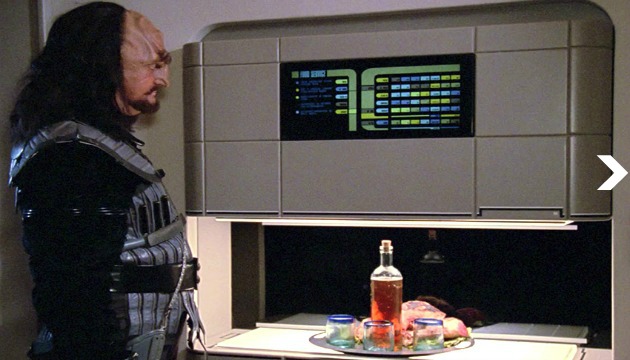
The Matter Replicator in Star Trek science fiction converts matter into whatever you want.  The Human Convertitron is the same hypothetical machine, only it converts matter into humans.

The Matter Replicator in Star Trek science fiction converts matter into whatever you want. The Human Convertitron is the same hypothetical machine, only it converts matter into humans.

It might be mildly disquieting to consider that we each have 19,290 slaves working for us.  Imagine waking in the middle of the night and discovering 19,290 slaves standing in the dark, packed into your room, spilling out into the streets, all waiting to serve you.

On the other hand, it’s a stunning thing to consider the extraordinary magnitude to which we are served by nature when we convert biodiversity to humans.

What nature does for us is equivalent to having 19,290 human slaves working for us 24/7 without any compensation, rights, or protection of their well-being.

It’s a good thing we don’t have a Human Convertitron because if we did and if we converted all life to humans, Earth would collapse almost instantly unless the 140 trillion humans knew how to make our environment habitable so that we and the other 7.2 billion (or that portion of legal age) can sip bourbon (with ice balls).

On the other hand, maybe if we saw ourselves as part of the community of life on Earth, rather than Masters of the Biosphere, things might play out differently.  Slavery is one of the darkest sides of human nature and while we may not see its ugliness in the concept of bioslaves, when we recast our biota into the equivalent of human slaves, an exercise meant to see nature differently, we discover how deeply disturbing it is to consider life on Earth our slave.  Perhaps if we had considered ourselves working in league with species, rather being masters of the Biosphere, we would view life on Earth in a way that would promote environmental sustainability and human wellbeing.

————————————————————————————————————————–

*Over the years, in foolish anticipation of one day writing a book entitled, Notes from an Increasingly Lonely Planet, I started collecting thoughts about the demise of our world that might convey ecology and evolution in unconventional, perhaps more interesting and even entertaining ways.  I worried that the bulk of environmental literature, especially books, prophesized doom, were alarmist, chastised their readers or humanity in general, or were otherwise off-putting.  I understand where environmental writers are coming from, but I wanted to take a different approach, even if the message might have unavoidably somber overtones.  These notes, however, just don’t come together well as a book, so I hope they might work as blogs.

This is my first installment of Notes in my year of practice blogging.

Standard
climate change, environment

If the Earth were flat, Iggy and Jim could go to Tokyo on the Nebuchadnezzar

I was listening to Iggy Azalea’s song, “I’m so Fancy,” and I decided to join the Flat Earth Society.

By admitting this I will probably get into some sort of trouble.  Scientists, such as myself, are thought to be classical music buffs, and if it were to emerge that some of us listen to pop or hip hop, our reputations would take a hit.

I suppose joining the Flat Earth Society could also get me into trouble, but I had to join.  I wanted to tackle a serious problem, one that we all know but live in denial of, one that is global in scale, and one that affects all of us – the staggering sphericity of Earth.

The roundness of the Earth is massively annoying and there seems no way around it.  But then I discovered the power of denial.  As a scientist, of course, I was skeptical about denialists’ claims, but when Senator James Inhofe nearly crashed his 1978 twin-engine Cessna into a construction crew on a closed runway in Port Isabel-Cameron County Airport in Texas, it all came clear to me.

Many chalked up Inhofe’s near fatal maneuver to his hubris.  The airport manager, Marshall Reece, said “I’ve got over 50 years flying, three tours of Vietnam, and I can assure you I have never seen such a reckless disregard for human life in my life. Something needs to be done. This guy is famous for these violations.”

James Inhofe recklessly endangering human life with his twin-engine Cessna   (background).

James Inhofe recklessly endangering human life with his twin-engine Cessna (background).

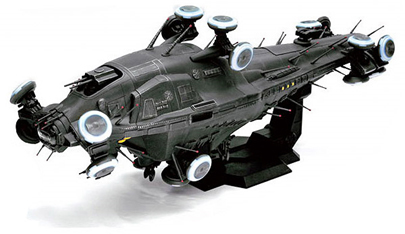
It’s not Inhofe’s hubris, however, that is the problem- it’s his denial of science.  The fault lies in the fact that his Cessna is designed and flies according to the laws of physics and is navigated on the principle that the Earth is round.  Inhofe’s reckless endangerment of human life is most likely because he is a science denier flying a plane that requires understanding science to fly it safely.  It would only be safe if he were flying something like the Nebuchadnezzar hovercraft from the sci-fi movie, The Matrix, a plane based entirely on fantasy and something he can better understand than physics.  He could fly the Millennium Falcon, Starship Enterprise or the Good Ship Lollipop, but I’m guessing the Nebuchadnezzar’s navigation is based on flat-earth theory, so it seems the appropriate choice.  I’ll explain below.

The Nebuchadnezzar form the "The Matrix."  It probably has a flat-earth navigation system.

The Nebuchadnezzar form the “The Matrix.” It probably has a flat-earth navigation system.

The inconvenience of Earth’s sphericity

Perhaps the only thing more scientifically proven than climate change is the fact that the Earth is round.  Earth’s roundness, however, like climate change, is really inconvenient, and while I understand that over 97% of scientists believe it’s round, it’s just not an idea consistent with what I want to believe.  There are many reasons that our planet’s being round is inconvenient, but two are really striking.  First, there are no straight lines on a sphere, which makes navigating Earth really difficult.  I can’t just get out a flat map and draw a line from L.A. to Tokyo and then take off in that direction – I would never get there.  If I stubbornly keep my nose pointed in one direction, because the Earth is round, I will stray from the circle that actually connects L.A. and Tokyo and instead spiral to the pole and my doom.  To actually reach Tokyo, you need a good clock, a compass, and you need to do lots of trigonometry to calculate how to compensate for the roundness of the world.  Let’s be honest, who among us does not find sines, cosines, and tangents (and don’t even get me started on secants) to be wretched things – SOHCAHTOA still gives me the willies.

Second, once you are only about 30 miles (18.6 km) on one’s way, the sphericity of the Earth means that things will disappear behind you – and that’s just plain spooky.  Sphericity is why Sarah Palin can’t see Moscow from Wasilla, why we can’t see Tokyo from L.A., and why shopping carts disappear over the horizon in Walmart Supercenters.

Let’s face it; the roundness of the world is a serious problem and no one is doing anything about it.

How to flatten the Earth

Turns out that the Flat Earth Society is doing something about the tyranny of sphericity.  Boasting over 500 members, the Society maintains a great web site along with a wiki, downloadable documents, member registry, and much more.

The Flat Earth Society has a nice map where the Earth is shown to be a disk with the Arctic in the center and as you go out to the ends of the Earth, you encounter a wall of ice.  Try it – walk in any direction from the North Pole and you indeed hit a wall of ice (though a lot of it is melting).  This wall of ice, mistakenly considered by sphereists to be another continent they call “Antarctica,” is kind of like the Wall in Game of Thrones, where the soldiers of the Night’s Watch guard the north of the Seven Kingdoms against the Others.  But Game of Thrones is fantasy, where flying is principally done by dragons and three-eyed crows.

The Antarctic is not a  continent, but a wall of ice and rock marking the ends of the Earth.

The Antarctic is not a continent, but a wall of ice and rock marking the ends of the Earth.  (Map available from the Flat Earth Society’s web resources.)

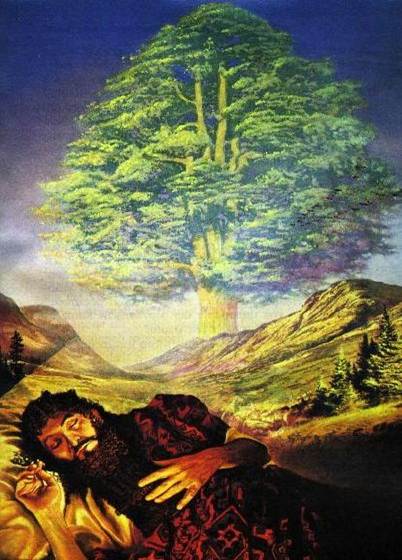
Conventional physics, trigonometry, and known travel distances on Earth seem to make the Earth being flat unlikely.  Flat-earth theory, however, is well grounded in biblical support and based on many other arguments, as explained nicely on the Society’s web site.  They point out, for example, that King Nebuchadnezzar’s dream was given to him by God, and in that dream he was shown a tree that touched the heavens and could be seen from every corner of the Earth before it was destroyed.

Earth must be flat if Nebuchadnezzar’s tree could be seen from everywhere.  For this reason, I presume the navigation system of the Nebuchadnezzar hovercraft is founded on flat-Earth principles.

King Nebuchadnezzar  dreamt of a tree that reached the heavens and could be seen from everywhere on Earth - support for flat-Earth theory.

King Nebuchadnezzar dreamt of a tree that reached the heavens and could be seen from everywhere on Earth – support for flat-Earth theory.

Faith in flatness

Ignoring science like climate change means reckless disregard for human life, but politicians avoid criminal charges by designing legislation to support their denial.  Inhofe, for example, had to undergo a program of remedial training as penalty for his reckless flying, so he introduced the Pilot’s Bill of Rights (Public Law 112-153) to protect pilots from what he deemed government overreach.  Similarly, 24 Republican Energy and Commerce committee members voted against the amendment to the Electricity Security and Affordability Act, denying climate change.  The benefits of such personal convictions produced over $9.3 million dollars in industry contributions to climate deniers on the committee and it also hobbled further “government overreach” (i.e., the Environmental Protection Agency regulating carbon dioxide emissions by power plants).

It seems one can use the political capital of the tremendous public admiration for adherence to personal beliefs and faith to counter the minor hit one takes from public disdain for ignorance.  So, in this spirit, I decided the Earth was flat.

All I have to say is:

“I’m no Earth scientist, but if you ask me, it’s flat.  I mean, just look at any map – they are all flat.  I’m not going to stand by and allow the American People to have to put up with things disappearing over the horizon and having to know trigonometry.  It’s a personal opinion, not a scientific fact.”

Championing my faith over science should earn me public admiration, maybe even enough to counter my likely reputational hit I take for listening to Iggy Azalea.

Iggy Azalea; physicist and flat earther?

Returning to Iggy’s song which started this whole thing—though she’s not on the Flat Earth Society’s roster, I get the distinct feeling from her song that she’s a sphericity denier.  I really like her catchy tune, but the refrain “I’m in the fast lane, from L.A. to Tokyo,” is what clued me into her subscribing to flat Earth theory.  The refrain refers to her huge fan base, but what’s puzzling is that there’s only ocean between L.A. and Tokyo.  Not a lot of music fans along this route, which is why I suppose it is critical for her to take the fast lane.  So what she must mean is that her popularity is global, covering the whole world from one end (L.A.) to the other (Tokyo).  A round Earth, however, has no ends, so if you simply mean from one point to the polar opposite, the polar opposite of L.A. is actually someplace between Madagascar and Australia, not Tokyo.  So she must think the world is flat, with the most distant points being between L.A. and Tokyo, and since travel between the two involves going over the Pacific, you want to be in the fast lane.

Iggy and Jim go to Tokyo

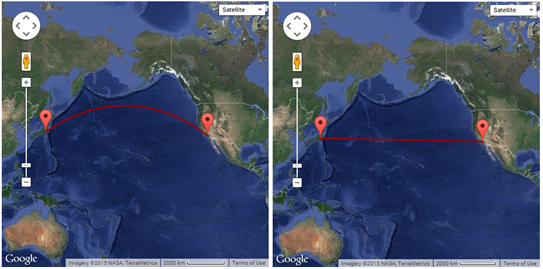
So if Iggy Azalea is a sphericity denier, it means she must have to deal with figuring out where the “fast lane” between L.A. and Tokyo is.  If you believe the Earth is flat you, then the fast lane is the straight line connecting L.A. and Tokyo on a flat map, or at least that would be the shortest path and hence the fastest “lane”.  This straight-line path, however, is 5,786 miles (9,312 km) long, while the shortest path between L.A. and Tokyo is actually much shorter – 309 miles (497.3 km) shorter.  If you plot this genuine “fast lane” on a flat map, it’s an arc skirting south of the Aleutians and, according to the scale on the map, appears longer than the straight-line connection.

The tyranny of sphericity means that one cannot simply go from L.A. to Tokyo  following a straight-line path (right).  You have to go in an arch (left).  Annoyingly, the right line is 309 miles longer, even though it looks shorter.

The tyranny of sphericity means that one cannot simply go from L.A. to Tokyo following a straight-line path (right). You have to go in an arch (left). Annoyingly, the straight-line path is 309 miles longer, even though it looks shorter.

So I was thinking, though it might seem strange, that if Inhofe decided to give Iggy Azalea and her entourage a ride in his Cessna from L. A. to Tokyo in the fast lane, I’m guessing, at a maximum speed of 174 mph (280 km/h) and a range of about 1,600 miles (2,600 km), by denying that the Earth is round, he would need not only extra fuel for the extra 309 miles but around two hours of extra stuff to talk about, which would most likely be Iggy Azalea’s physics lessons (“And I’m still in the Murda Bizness; I could hold you down, like I’m givin’ lessons in physics”).  He’d have to make stopovers in the Pacific, though given places like Kiribati are sinking due to climate change, his options are limited.  More than likely, he would recklessly endanger Iggy Azalea and her entourage, although if they also happen to be climate deniers, then they would not fault him.  For this reason, they take the Nebuchadnezzar hovercraft instead of the Cessna

OK, a wildly implausible scenario, Inhofe taking Iggy Azalea and her entourage in the fast lane from L. A. to Tokyo aboard the Nebuchadnezzar, in exchange for physics lessons, navigating by the flat earth map downloaded from the Flat Earth Society’s website.

But compared to what’s going on in Congress concerning climate change, my scenario is far more believable.

——————————————————————-

Postscript

Sadly, though I joined the Flat Earth Society, I discovered today that the Earth is still round.

As Jean Baudrillard, the French philosopher said, “Reality is a bitch.”

Standard
environment

The “Yo momma” Solution

Seeing the crazy way that everything is connected to everything else is one of the best ways to find solutions to environmental problems.  Consider, for example, the connections between the financial crash of 2008, Morgan Stanley (the mega finance corporation that borrowed $107.3 billion from us), “yo momma” jokes, and extraterrestrials – when you put it all together, it points to a possible cause and a solution to global environmental problems like mass extinction, habitat fragmentation, deforestation, and emerging diseases.  I have to admit the chain of logic in this thesis of connections is a bit iffy, but I can explain.  Let’s start at the beginning of the chain.

The Financial Crash of 2008

The boom times running up to the 2008 crash were, in part, attributable to a huge financial house of cards built on a foundation of bad loans.  These loans were mortgages on overpriced homes purchased by people who couldn’t afford them.  I’m simplifying; it’s a complicated story, and I’m no economist, so I’ll leave the full story for others (like Paul Krugman or Daniel Quinn Mills) to tell, but for our purposes here, suffice it to say these “sub-prime” mortgages were purchased by financial institutions that were locked into a complex scheme of largely unregulated risky monetary practices that totaled in the trillions.  When the scheme collapsed Lehman Brothers tumbled, and Morgan Stanley followed quickly along with other major finance institutions like Merrill Lynch, AIG, Freddie Mac, Fannie Mae, Bear Sterns, Goldman Sachs, and many others; all once deemed so powerful and secure they could never fail.

Morgan Stanley

Morgan Stanley fell in part because its hedge fund operations were financed by the purchase of those risky mortgages.  What struck me as ridiculous was Morgan Stanley’s claim that it was a victim like everyone else, not one of the perpetrators.  It claims it never knew the true nature of the risks it was taking.

Morgan Stanley

Seriously?

So when I read Nathaniel Popper’s article in The New York Times (December 29, 2014) that investigations reveal that Morgan Stanley did, indeed, know the risks and, in fact, was instrumental in the growth of bad mortgages, I wasn’t surprised.

What caught my eye, however, was a quote from Morgan Stanley executive Pamela Barrow’s e-mail to her colleague.  Ms. Barrow called the people who bought the houses (with a few added punctuations of mine), “first-payment defaulting, straw buyin’, house-swappin’, first-time wanna-be home buyers.”

Oh snap!

Though not exactly the kind of sharp-tongued repartee of a Comedy Central celebrity roast or the clever verbal sparring of kids ranking or playing the dozens (insult contests) in my school days, Ms. Barrow shows some skill.

But where it really gets interesting is when she continued with a solution that could have saved Morgan Stanley and prevented the 2008 crash if it were implemented.  She said,

“We should call all their mommas.  Betcha that would get some of them good old boys to pay that house bill.”

That’s when it hit me and I had my “aha!” moment.

Yo-momma jokes

Where I grew up in Bedford Stuyvesant, mommas, in the abstract, were serious business – one did not talk about another’s momma unless it was to agitate.  Because of this, “yo momma” jokes were common in ranking or the dozens – the jokes were not actually about mothers, they were just insults meant to test one’s resolve.

Consider, for example, “Yo’ momma’s so ugly, when she threw a boomerang, it didn’t come back!” or

“Yo momma’s house is so small, there isn’t room to change her mind,” or

“Yo momma’s so poor, she does her drive-by shootings by bus,” or

“Yo momma’s so dumb, she stood on a chair to raise her IQ.”

In a moment of honest reflection, when Ms. Barrow considered the risk inherent in Morgan Stanley’s growing acquisitions of sub-prime mortgages to fuel their hedge funds, she must have entertained inserting the clause in the loan agreements that read, “Upon failure to make payments, we’re calling yo’ momma, who, incidentally, is so stupid she thinks a sub-prime is a steak.”

Her solution of threatening homeowners with the possibility of having their mommas drawn into the matter and possibly having to defend their mommas (a cultural obligation rather than a rule of law) if they defaulted on their loans was brilliant.

Extraterrestrials

So here’s my thesis – it is common to consider Earth our mother, and, indeed, the mother of all life on Earth, so Barrow’s momma-based strategy could work, except for one complication – when ranking or playing the dozens, one’s opponent has to be someone outside your family, your friends, or your posse.  When it comes to Earth, who is momma to us all, the yo-momma joke has to be leveled by someone from another planet (their momma being their planet).

A somewhat creepy view of mother Earth, but it works. (Image from http://planetoplano.blogspot.com/).

So, if the SETI Institute, those folks searching for signs of extraterrestrial intelligence, were to one day receive a staticky, crackling set of communications that that splashed across the news media around the world, and roughly translated as:

“Yo planet is so depauperate, it makes the Tabernacle Choir look speciose!” or

“Yo planet is so fragmented, it makes Humpty Dumpty look good!” or

“Yo planet’s got so many emerging diseases, it makes a zombie apocalypse feel like a Club Med vacation!” or

“Yo planet’s climate is changing so fast, it makes a Kardashian romance look like a long-term relationship!” or

“Yo planet’s so deforested, a Brazillian wax leaves more bush!”,

people would be outraged.  Well, yes, and a bit surprised about the nature of our first contact.  After getting over the shock of discovering we are not alone, however, we would be motivated to respond,  “Oh yeah?  Well yo planet is so f#@!ed up, even James Inhofe thinks your climate is changing!”

OK, since waiting for extraterrestrials to taunt us is a bit farfetched, I do hope the chain of logic behind the idea is at least clear.

One might say that Earth as mom is already a well-known environmental trope, but it doesn’t resonate with everyone.  But maybe yo-momma jokes about our Earth, our mom and mom to all species and mom to our vibrant, living world, might just get even the most apathetic exorcised enough to defend our momma and her honor.

Standard
biodiversity, environment

Home is where you hang your children’s children’s ….hat: Life at the bottom of the sea and elsewhere.

In 2006, a few years after we arrived in Manhattan and were still reeling from big city rents, The New York Times reported that a certain Mr. Freeman, mostly out of curiosity, posted an ad for renting a hole in a wall in his apartment – $35.00 a month.  He had a dozen inquiries by day’s end.  Home is, after all, where you hang your hat.

In the case of life on earth, home is where eventually at least one of your children can hang her hat, which means, by extension, it is where at least one of your children’s children can hang their hat, and so on.  It hardly matters if it’s a hole in the wall or a luxury condo, though we’d all prefer the latter, no doubt.

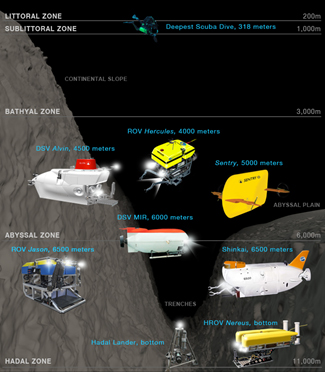
When it comes to hole-in-the-wall homes, the ocean’s hadal zone probably tops the charts as the worst place to live.  The hadal zone is anyplace between 4 to 7 miles below the ocean’s surface.  That’s roughly 6 to 11 kilometers down – deeper, as marine biologists love to point out, than Mt. Everest is high.

Deep though the hadal zone may be, it’s a tiny place; only a couple percent of the entire ocean floor that totals over 100 million square miles (multiply by 3 for kilometers).  It’s a tiny area because most of the zone is made up of deep cavernous drops or oceanic trenches and while there are plenty of oceanic trenches, they don’t cover much area.

If your home is in a hole at the very bottom of the sea, you’re living in the hadal zone.

Freeman’s hole in the wall is a luxury condo compared to hadal holes at the bottom of the sea.  The hadal zone doesn’t look so bad when we are treated to pictures and videos of the place, but these images are taken with custom-made cameras mounted on ruggedly engineered diving robots or by people in deep-sea submersibles that have lots of lamps for taking those images.

Deep sea submersibles - letting us see a word that is largely pitch black.

Deep sea submersibles – letting us see a word that is largely pitch black.  From the HADES web site – note the hadal zone at the very bottom.

In reality, sunlight only penetrates down, at best, to maybe 660 feet (200 meters).   Thus, the hadal zone is even darker than the underworld for which it is named because there is absolutely no light down there, except for the occasional flicker of bioluminescence.

It’s not just a pitch black world, it’s a creepy world – a place under a perennial drizzle of detritus, dead microbes, and particulate poop from the creatures above.  Occasionally, a corpse might make it to the bottom if scavengers above missed it as it sank slowly through miles of ocean and into a trench, but that won’t happen often.  It’s also near freezing and the pressure down there is a thousand times what it is up on the Earth’s surface.

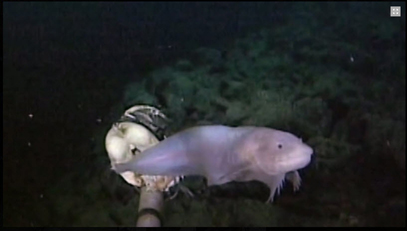
The hadal zone hardly seems a neighborhood where anything would want to live.  And yet, scientists from the Hadal Ecosystem Studies program, or HADES, recently broke the record for the deepest fish ever found.  So, in spite of what must be the most extreme conditions on Earth, there are creatures that call it home.

But when you think about it, though the hadal zone is pretty extreme, the truth is, much of the world is inhospitable – too hot or cold, too dry or wet, and/or too little food or energy to go around.  Of the 330 million cubic miles (about 1,200 million cubic kilometers) of ocean water, only 14 cubic miles (or just 60 cubic kilometers) is in the sunlit or euphotic zone.  The euphotic zone is what we think of when we think of the ocean – kelp beds, coral reefs, eel-grass beds, or the surface waters where we see jellyfish, sun sharks, and sea turtles, but the vast majority of the ocean is a dark, cold place.  The same is true for terrestrial Earth – we tend to think of majestic forests filled with trees, flowering plants, buzzing insects, and a host of birds and mammals, or we might think of grasslands with elk and bison and wildflowers everywhere.  But vast regions of terrestrial Earth are dry (16%) or just rock and ice where little can live (25%).  It’s hard to say what percent of land is perfect for life, but if we were to consider that to be tropical habitats – that’s only about 24% of the terrestrial world.

Yet, no matter how inhospitable a place on Earth is, whether the dark hadal zone or the icy arctic, you will almost always find species that call it home.  They and their children and their children’s children, and so on, live there generation after generation.

When I think of our Biosphere, I think of New York City – home to millions.  It’s not the few who live in mansions, townhouses, luxury condos, or spacious, well-furnished, well-lit abodes that make NYC the vibrant city it is, though the wealthy often serve some important roles.  It’s the writers, musicians, artists, short-order cooks, police, firefighters, medics, teachers, scientists, architects, engineers, students, bus drivers, train conductors, garbage collectors, and the millions of people who live and work together that make the city work.  Their homes are modest places, though holes in the wall are probably rare.

The Biosphere is the same as vibrant mega-cities – all its inhabitants live and work in every space imaginable. The hadal zone is no luxury abode, but it’s home to hundreds of species, two thirds of them living nowhere else, and if we could figure out how to estimate how many archaeal and bacterial species live down there, the number would be much bigger.  It’s not just weird fish (including eels) down there, but amphipods, crabs, isopods, sea cucumbers, mollusks, lots of microorganisms, and probably many species waiting to be found.  The hadal zone may be ecological holes in the wall, but then most of Earth is a challenging place for life.  Yet, 8.7 million species call it home, and make for a rich and vibrant world.

Life values every place on Earth as home.  Strange that not all of us value Earth in the same way given that we too make our homes here.

Standard
Uncategorized

Children of the Tree of Life

I’ve never been to Pakistan, though my father, who was born before the country’s birth, saw it as his homeland and after raising a family here in the US, returned to pass away on its soil.  Americans (all kinds) think me Pakistani or Indian.  It’s a strange American custom – to consider anyone outside their sense of the “American ordinary” to be non-American.

“Where are you from?”

“New York.”

“No, I mean, where were you born?”

“San Francisco.”

“No, I mean, where are you from?

Sadly, I’m just an American, though I’m tempted to say something exotic, like “The Seychelles,” in a thick French accent.  I’ve never been there, but then, I‘ve never been to Pakistan either.

Oddly, Pakistanis seem to think me Pakistani too, as though I’m a branch off an ancient tree of humanity that’ s rooted in Pakistan, though the country was only created in 1947.  It’s interesting to me how often I am approached to be brought into the fold of something I really do not know – no matter that I was born here, have never been to the country and don’t speak Urdu.

Years ago, I realized that the only sensible answer to questions about one’s identity and allegiance is simply “I am from the Tree of Life, a citizen of the Biosphere, kin to 8.7 million species; my trade is biogeochemistry, the universal trade of all organisms.”

That sounds nerdish, Lovelockian, or Earth Motherish, however.  Safer to say, “The Seychelles.”

By dodging the question of “where were you born?” I’m really trying to avoid tribalism, something I feel is an unfortunate and destructive trait of mankind.  To ask the question “where were you born?” is to reveal subscription to tribalism – that we belong to some kin, clique, or clan, no matter that we are all one species.  In fact, our species is only a couple hundred thousand years old – still a twiglet, in evolutionary terms.  A miniscule twiglet of a 3.5 billion year old tree made up of millions and millions of branches.

On the spectrum of finding human tribalism wondrous to finding it abhorrent, I cannot find where best to stand, so I avoid the issue.  Some folks are obsessed with their “roots.”  But they tend to stop once they identify with some monarch or emperor.  Logically, if they kept going, they would wind up with Mitochondrial Eve, the mother of us all, who was born of non-Homo sapiens sapiens primates in East Africa some 200 thousand years ago.  But I don’t understand why one would stop there?  Personally, I like going back to the cyanobacteria who gave us oxygen, but I’d be happy to go back to the first cell, maybe even the first microscopic lipid bubble that contained the RNA, DNA, proteins, and carbohydrates necessary to replicate itself.

What’s wrong with tribalism, seeing oneself as a branch or twig or twiglet of humanity rather than as just another member of the living world?

Tribalism is the engine of human disparity, inequality, and inequity, and ultimately why the living world is facing an uncertain future.

My Facebook friends from Pakistan do not understand why the world seems to have already forgotten the slaughter of 135 children in Pakistan by deranged people motivated to murder by a pathological form of tribal exceptionalism, by which I mean seeing one’s tribe as exceptional, superior to others, to the point that one can mistreat or even kill those of other tribes.  In this case, the tribal exceptionalism is Taliban supremacy.The Pakistani Taliban, self-confessed perpetrators of the slaughter, having previously bombed or burned more than a thousand schools, vow to do more.  It is beyond comprehension, and beyond humanity.  How could it have happened?

In writing on the wanton killing of endangered bustards by a Saudi Prince hunting in Pakistan, I was reminded of how complex Pakistan is as a small country bordered by the much larger India, Iran, Afghanistan, and the complex and troubled Kashhmir and Jammu lands in the north. It is embedded in a turbulent mix of cultures, ideologies, politics, history, economics, and now, environmental change.  Amidst such complexity, the unthinkable can happen.  With so many endogenous and exogenous forces at play, inevitably something terrible will happen in spite of Pakistan’s best efforts.  In spite of the turmoil and complexity surrounding Pakistan, it is also home to the first woman leader of an Islamic country (Benazir Bhutto) and home to this year’s Nobel Peace Prize winner (Malala Yousafzai, the girl who survived being shot by the Taliban for the audacity of going to school).

The more complex and turbulent the environment we live in, the more exogenous forces are likely to get the upper hand.

Slaughters, mass killings, genocide, the outcome of complex and turbulent environments, are all too common in our species, but we are outraged by the murder of children – no matter the tribe.

When we mourn the death of children at the hands of men, we mourn the loss of children of the Tree of Life.

And yet, in spite of outrage, in 2012, around the world, 10 million children were forced into prostitution.  More than 168 million children were exploited as laborers, often under terrible and hazardous conditions.  5 million died from hunger and malnutrition, and the gruesome numbers go on.

In the US, 1,640 children died from abuse and neglect, 88% under the age of 7.  Between 2005 and 2009, 1,579 children were murdered here.  And though  hunger and poverty have been rising at a steady clip (1 family out of 10 struggles to put food on the table in our country), in the most recent US budget, the Supplemental Nutrition Assistance Program, designed in part to insure child welfare, was slashed by 8.6 billion dollars.

Of the 150 gun laws proposed in the US since the Sandy Hook massacre of 20 children by a deranged gunman (note frequent use of the word “deranged”), only 109 laws have been enacted, but the vast majority (70) of them loosen gun restrictions.  We want our guns allegedly to protect our family, kin, clan, and tribe (oh yes, and to hunt).

Today in our country it is easier than ever before to kill children with guns.

There’s no overcoming tribalism, and my friends and colleagues think it wondrous (they term it “cultural diversity,” but that is the manifestation of tribalism), the suffering of children being an unfortunate outcome that needs to be redressed.  I love cultural diversity, one of the reasons I love New York City as a home, but if cultural diversity can only be generated by tribalism, then it isn’t worth it.  I would rather see people in love with one another and their children than in love with their tribe.

Globally, most of the trends in child welfare are in the right direction – declining child labor, increasing child health, fewer girls killed or genitally mutilated, and in our country, greater awareness and lower tolerance for the abuse and slaughter of children.  But increasing economic disparity and environmental disequilibrium make sustaining positive trends difficult.  This is why the greatest champions of the welfare of children are those who work tirelessly to build broad environmental sustainability and insure that the world remains a robust home for all of us, especially children, who are the first to suffer when food, water, and energy becomes scarce, as climate changes, diseases emerge, and conflict arises.

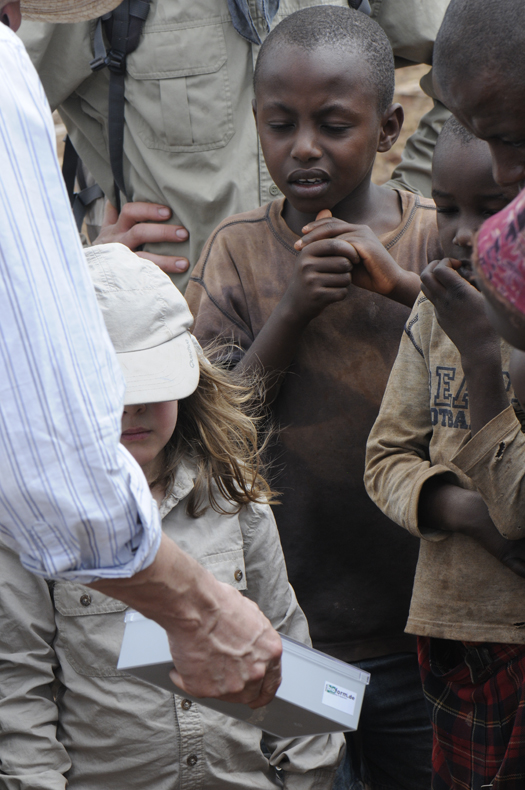
On Mt. Kilimanjaro, Tanzania, children learn about bee diversity.  Germans and Tanzanians are working together to preserve biodiversity so that they may better survive upcoming climate change.

On Mt. Kilimanjaro, Tanzania, children learn about bee diversity. Germans and Tanzanians are working together to preserve biodiversity so that they may better survive upcoming climate change.

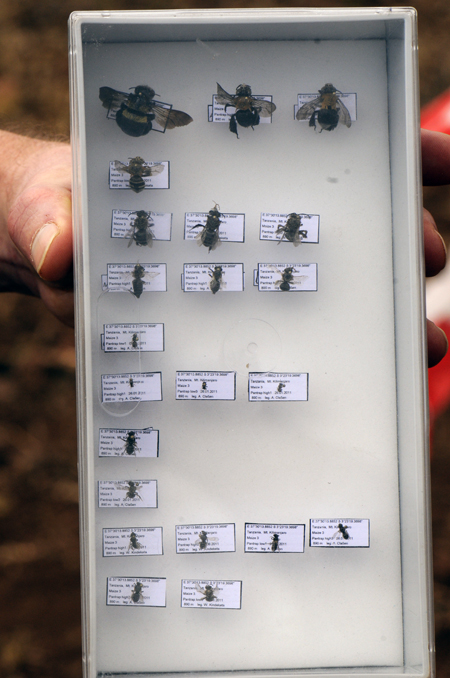
Bee diversity; what the kids are looking at in the box.

Bee diversity; what the kids are looking at in the box.

Standard
Uncategorized

Waterboarding America

I like the idea that an executive summary can be 524 pages long since I famously go on too long about most things.  Perhaps it was not possible to distill the six thousand page Committee Study of the Central  Intelligence Agency’s Detention and Interrogation Program. It’s terrible that this Report has so much to say about our country’s torture – 119 people “detained,” a quarter of whom were wrongfully held.

The centerpiece of the Report is waterboarding.  Much of the outrage, however, concerns the fact that people whom we entrusted with our national security lied to us, took the law into their own hands and otherwise abused the trust we gave them.  It seems the CIA, at a time when the country seemed willing to give up all its freedoms and break every rule to fight terrorism, became dysfunctional, disorganized, incompetent, greedy and deceptive – at least that’s the New York Times’ synopsis of the Report.

Waterboarding is drowning without the killing part – the waterboarded detainees were physically and psychologically scarred for life, but they were never drowned.  If any had actually been drowned, there would be much more outrage.  The one who died, Mr. Gul Rahman, died of hypothermia – he died shackled, nude, alone on a concrete floor, the officer responsible considered one of the agency’s best.  In hypothermia, you pass out, some say even experience euphoria in the final moments before you die.  When you drown, suffering is horrible and the last moments are violent and desperate.  But no one was drowned.

When I think of innocents drowning, I think of Hurricane Sandy – 117 died, which is close to the number of CIA detainees – a third of the deaths were from drowning.  Hurricane Katrina was much worse – 1,300 died, almost half from drowning.

But wait a minute; they died because Congress, when it comes to climate change, is dysfunctional, disorganized, incompetent, greedy and deceptive.  Why no kerfuffle?

The Senate Report, on the other hand, has created quite the kerfuffle.  Those who wilfully ignored the fact that torture does not work (as, ironically, determined by the CIA in its own 1989 report), ignored our commitment to never torturing prisoners.  It’s our domestic and international policy.  It’s international law.  Yet, officials we trusted knowingly stood by and let torture happen, or feigned ignorance and let it happen, or let their ideology dictate their action and let it happen – those who betrayed our trust should be brought to justice!

Heads will roll!

Well, of course, not literally.  That would be cruel and inhuman, which is forbidden by our Constitution.

It’s a bit uncertain whose heads will metaphorically roll.  Who will be brought up on criminal charges?  Some think President George W. Bush, Vice President Dick Cheney, Donald Rumsfeld, and Secretary of State Condoleeza Rice should be charged.  Maybe George Tenet, Porter Goss, and Mike Haydon, former directors of the CIA and John Brennan, current director?  John Yoo, John Rizzo, Jay Bybee, Alberto Gonzales, Cofer Black, and maybe Bruce Jessen and James Mitchell, psychologists who helped with the methodology.  That’s well over a dozen.

But I keep thinking of those who drowned in Katrina and Sandy.  Held hostage by poverty, discrimination, and a government who knowingly and wilfully ignored what climate change science has been telling them for 20 years.  If seventy percent of the public and 97% of scientists agree that climate change is real and our officials were entrusted to represent us, then they abused our trust – just like those named in the Report. The arguments of climate deniers are contrived, chaotic, ever-changing, and many deniers are supported by money from industry or the Koch brothers, which reflects influence by ideologues, politics, or just plain greed.

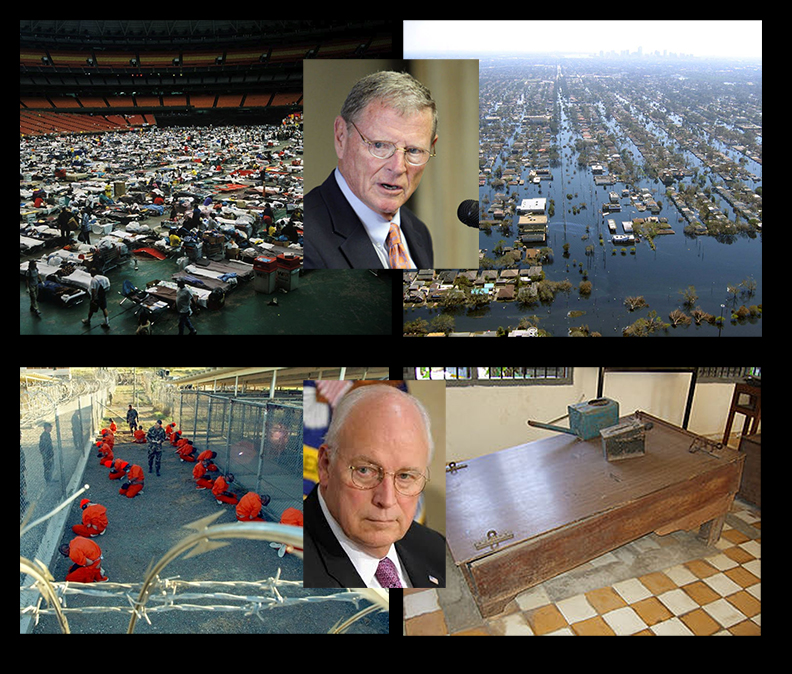
Senator Imhofe sanctioning the waterboarding America and Vice President Cheney sanctioning waterboarding.

Senator Imhofe sanctioning the waterboarding America and Vice President Cheney sanctioning the waterboarding of CIA detainees.

The World Health Organization estimates that 150,000 people are currently dying every year from climate change – although the causes are quite varied – only some of them are death due to drowning from extreme weather, like hurricanes and floods.

It seems that climate deniers in Congress and their backers reflect dysfunction, disorganization, incompetence, greed and deception.  But wait a minute, this is exactly what everyone is upset about concerning the CA waterboarding detainees.

So doesn’t this make climate change deniers, like Senators Imhoff, Cruz, Enzi, Johnson, McConnell, Vitter, Coryn, and the majority of the Republican Party (only 8 are not climate change deniers), the same as those who condone waterboarding?   Too many to list.  Desmogblog.com list over 260 prominent climate change deniers – a lot bigger list than those condoning CIA waterboarding

It seems like climate change deniers are waterboarding America – only in this case, people actually drown.

Standard
Uncategorized

Bustards, Beetles, and Viagra

My spouse told me that a Saudi prince, with a huge, expensively kitted out entourage, went to Balochistan, Pakistan not long ago and killed 2,100 endangered houbara bustards – 2,000 more than his permit allowed.  The web was filled with shock and outrage, in part because many believed that this beautiful bird, on the verge of extinction, was killed because they are considered by some to be aphrodisiacs.  “Is there any more ridiculous reason to kill an animal?” asked Naeem Sadiq, a Pakistani activist with a name uncannily similar to mine.

Posted widely on the web, a picture of a bustard hunting - the modern way.

Posted widely on the web, a picture of bustard hunting – the modern way.

That’s a great question!  The answer is easy when you consider stimulants, experiencing a romantic evening, blister beetles, and penile erection.

OK – let’s start with stimulants.

Stimulants are amazing!  When an electrical impulse triggers a neuron to fire, it releases a chemical message to other cells.  The chemical signal, however, has to leap across a gap to get to the other cells.  This gap, or synapse, is the slimmest of spaces imaginable – it’s roughly 30 nanometers across or about one three thousandth the thickness of a sheet of paper.  Yet it’s in this impossibly small space that stimulants, like coffee and crack cocaine, slip in and mess with nerve signals.  This means that when the brain processes all the signals it gets from the surrounding world (sights, sounds, smells and so forth) and creates what we experience, stimulants can alter that experience even though the surrounding world hasn’t changed.

Consider the experience of a romantic evening.  If the sights of an attractive partner, the warmth of a crackling fire, the sounds of Nat King Cole on a muted MP3 player, and a complex milieu of culturally and socially tuned behaviors all align themselves just right, one might experience a romantic evening … which can mean sex, which, if at least one guy is involved, often means an erect penis.  I know that’s rather unromantic, but that aside, suffice it to say that romance and erect penises are not necessarily easy things to engineer.  Stimulants, at least in theory, can change this.  Add to the mix of evening activities imbibing alcohol, eating oysters, chocolates, ginseng, the testicle of a bull, snake meat, bark of the yohimbe tree, Brazilian potency wood, MACA root, the penis of a tiger or dog, eating penis- or vagina-shaped mushrooms sautéed in butter, ground horn of a rhino, the meat of a pangolin or gecko, and possibly hundreds of other stimulants, and the experience is altered even though the surrounding world was not – same partner, same crackling fire, same music, different experience.

Now, enter the blister beetle and the bustard.

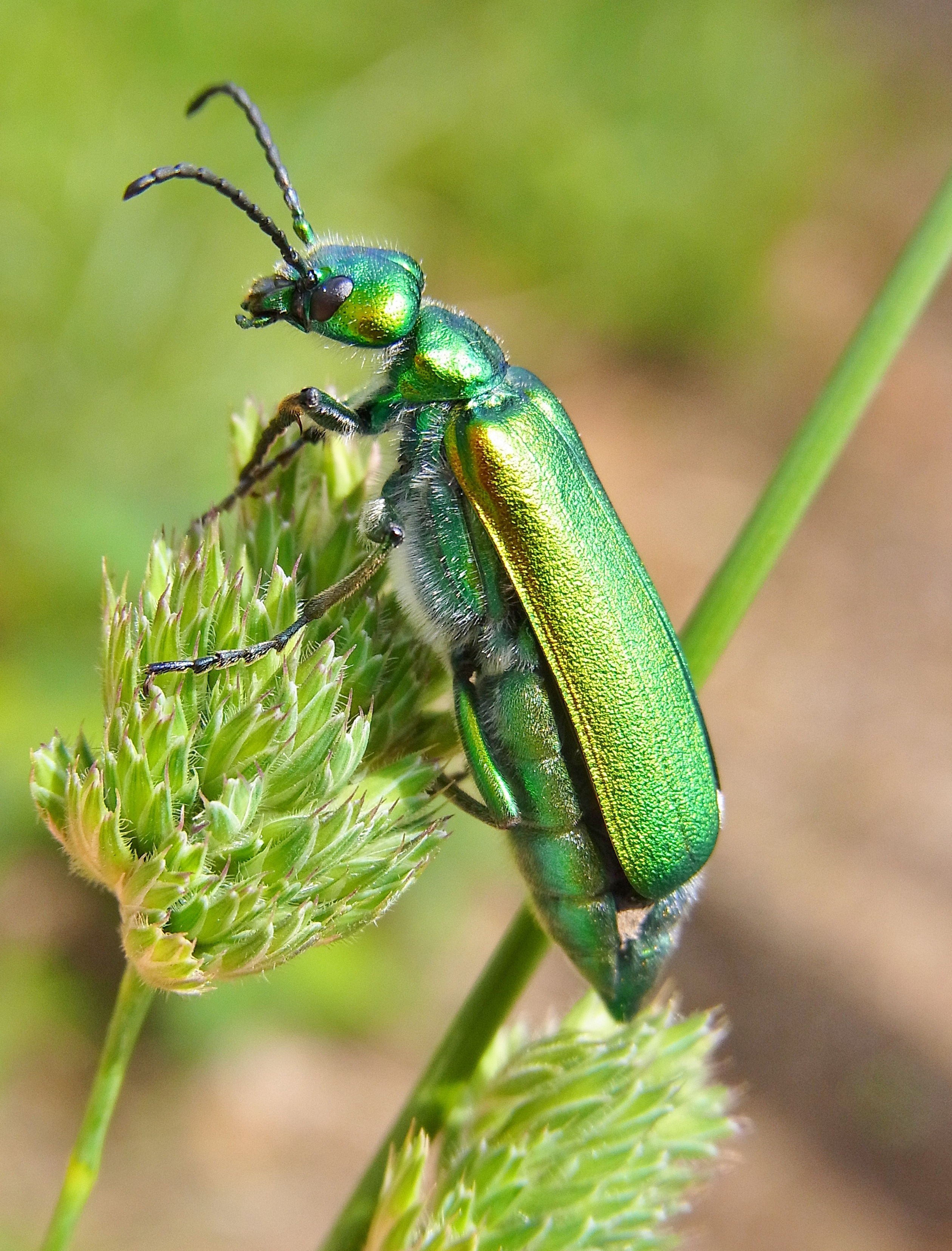
The Spanish fly is actually a blister beetle ( Lytta vesicatoria) whose noxious defensive chemical is toxic to people and bustards, but its toxin, cantharidin, in small amounts, is believed to be an aphrodisiac.

The Spanish fly is actually a blister beetle ( Lytta vesicatoria) whose noxious defensive chemical is toxic to people and bustards, but its toxin, cantharidin, in small amounts, is believed to be an aphrodisiac.

Blister beetles are famous for blasting attackers with cantharadin – a toxin strong enough to cause blisters on contact and to kill if ingested. Weirdly, blister beetles are believed to be aphrodisiacs, commonly known as “Spanish flies,” even though they obviously are not flies.  The way it works is that a sub-lethal dose of cantharadin induces vascular inflammation of the genitourinary tract in men and women – it’s hard to imagine inflamed penises and vaginas as romantic.

So all this got me to thinking.  In October, Carolina Bravo and colleagues published in PloS One, a leading scientific journal, a study suggesting that great bustards eat just enough blister beetles to ward off gut infections and parasitic worms.  They also noticed that males eat more blister beetles than females and that females check out the anus of males during courting, which is where you’d look (if you were a female bustard or, in this case, a scientist) to see if there were worms or any signs of a poorly functioning gut.  The authors suggest, though they really didn’t prove it, that male bustards eat extra blister beetles to self-medicate and show their healthiness so when a female comes to check their anus out – bingo!

So here’s my completely unsubstantiated scientific hypothesis – maybe the houbara bustard, like the great bustard, also eats blister beetles and that’s why it supposedly has aphrodisiac-like properties.  It’s much safer to eat a bustard that ate blister beetles than it is to eat blister beetles.  And while inflammatory irritation of the penis and vagina is not exactly romantic, death certainly wrecks a romantic evening.

The Prince, however, most likely claims that they are not aphrodisiac seekers.  Rather, they are falconers like their nomadic ancestors, the Bedu, who would capture falcons, hunt bustards to supplement their meager diets, and then release the falcons and move on.

Now we can answer Sadiq’s question.

Yes, killing bustards to allegedly keep a tradition alive is more ridiculous.  According to one account, the Prince and entourage fly in on private jets, have roads and luxurious accommodations built, bribe government officials to kill vastly more birds than they are permitted, enjoy lavish meals, satellite telephones and wi-fi, and drive luxury SUVs.  This is not keeping the Bedu tradition of falconry alive.  It is simply indulgent, repugnant “sport”.

That’s not to say that killing bustards for their aphrodisiacal properties isn’t ridiculous. It’s just a tiny bit less ridiculous.

Standard
Uncategorized

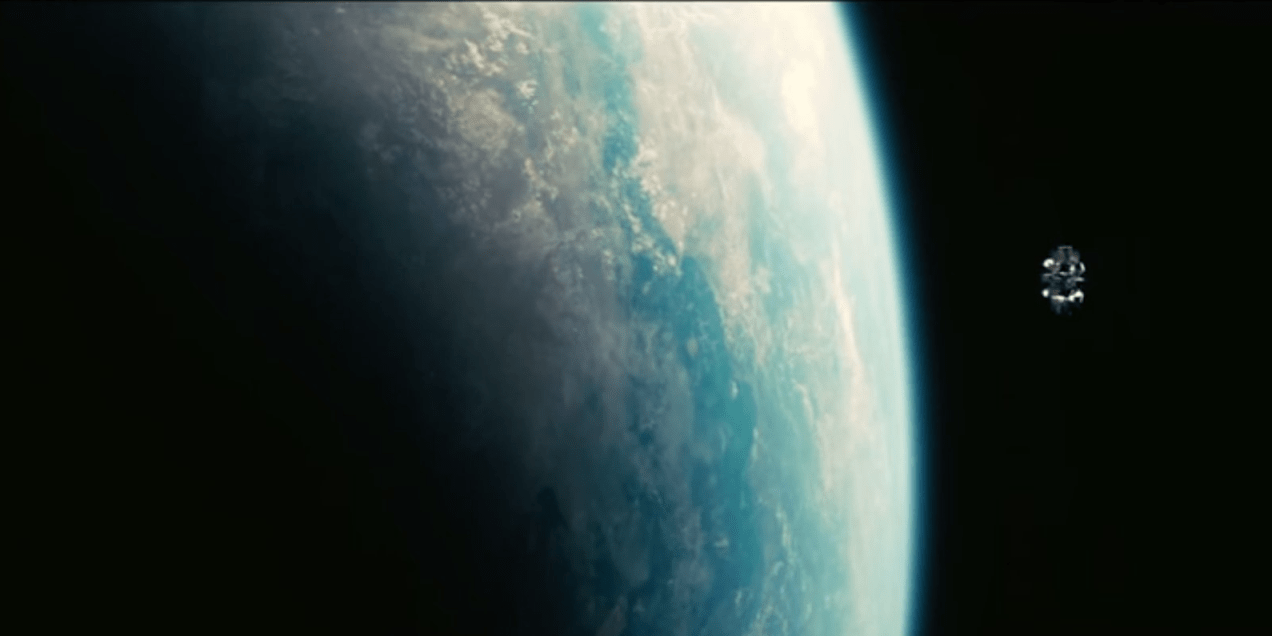
Interstellar’s environment – in IMAX!

IMAX is expensive, but it’s great to see a movie on a giant screen with big sound, especially sci-fi movies like Interstellar, where space travel takes you across vast vistas of space and there are lots of ear-shattering sounds of space ships crashing and exploding.  Interstellar champions itself as a novel sci-fi movie that will make you think about physics – time, gravity, multiple dimensions – it’s a very cosmic movie.  Kip Thorne’s book, The Science of Interstellar, written in anticipation of the success of the movie, is supposed to help moviegoers whose interest in physics is piqued by the movie.  Thorne has co-authored with Stephen Hawking about black holes and time warps and was a consultant for the movie.

Interstellar ’s physics may have been carefully constructed with the benefit of expert input, but its environmental “science” is just awful.  This horrifically bad environmental science is odd because the whole premise of the movie is that Earth is dying, which is an environmental issue.  While there are millions of ways one could imagine, scientifically, how our Earth might die, the Nolan brothers who wrote the movie (the brothers are known for their Batman movies and mind teasers like Inception and Memento), seemed to have consulted no one on getting the environmental science right.

The environmental science may lacking, but its environmental ideology is all too apparent and is passed off as science.  The movie’s environmental ideology is what I often refer to as anthro-exceptionalism – the belief that we are an exceptional species.  I blogged about this earlier when considering Intelligent Design and Creationism – the idea is that the purpose of 14 billion years of cosmic history was to produce us – sentient beings capable of understanding and therefore appreciating how wonderful the world is.  The core ideas of anthro-exceptionalism are:

  1. the more babies, the better – it’s biological, it’s natural, it’s not subject to question;
  2. humanity’s prime directive is the prevention of its extinction – that’s what evolution is all about;
  3. the environment is out to get us – nature and the cosmos are bastards and set against us;
  4. physics and engineering are vastly more interesting than ecology and evolution – we can bend the laws of physics (as in Interstellar), but ecology and evolution simply catalog the unfortunate, dull, immutable facts about life; and
  5. no matter the global crises, we will find a way out – even though the root cause of modern global crises is usually us.

I don’t take issue with subscription to these beliefs; indeed many of my friends and colleagues subscribe to this ideology.  What one has to watch out for, however, is when subscribers to anthro-exceptionalism mistake their beliefs for science or worse, allow their ideology to influence their research.

It’s hard to maintain the willing suspension of disbelief when the movie’s explanation for why the Earth is dying has to do with agricultural blight (caused by deadly pathogens of crops), dust bowls, and the loss of oxygen, all portrayed as if we lost our struggle against a cruel and indifferent world.  It never occurs to the Nolan brothers that the problem lay in the fact that we allowed our population to reach extraordinary numbers that were wholly dependent on a handful of fragile and vulnerable crop species.  It was a formula for disaster.  That’s why the Earth was dying in Interstellar, not because nature had conspired against us.

In Intersteallar, halcyon times are portrayed as times when fields were green, we could play baseball and eat hotdogs rather than popcorn, and we had large families.  But the dying Earth was due to that being our vision – the dying of Earth was our doing, not something inherently flawed in nature.  The absurdity of Interstellar’s new world is that it seems to be exactly the same as the one that died – a world made up solely of monocultures, baseball, and large families.

While the environmental science is rubbish, Interstellar is still immensely entertaining and because its environmental ideology reflects popular beliefs, few are likely to be bugged by its nonsensical environmental science.  The human drama (love between a father and daughter), imagined technology (cool robots and spaceships), suspense (will they survive?), and the astrophysics (space travel, exoplanets, worm holes, and the 5th dimension), are what draws the big crowds.

Still, what if Interstellar considered how amazing our Biosphere is and imagined its demise because of accidental mismanagement and mass extinction and then attractive, smart people scoured the universe for solutions, found them, and came home to rebuild.  That would make for an incredible IMAX experience.

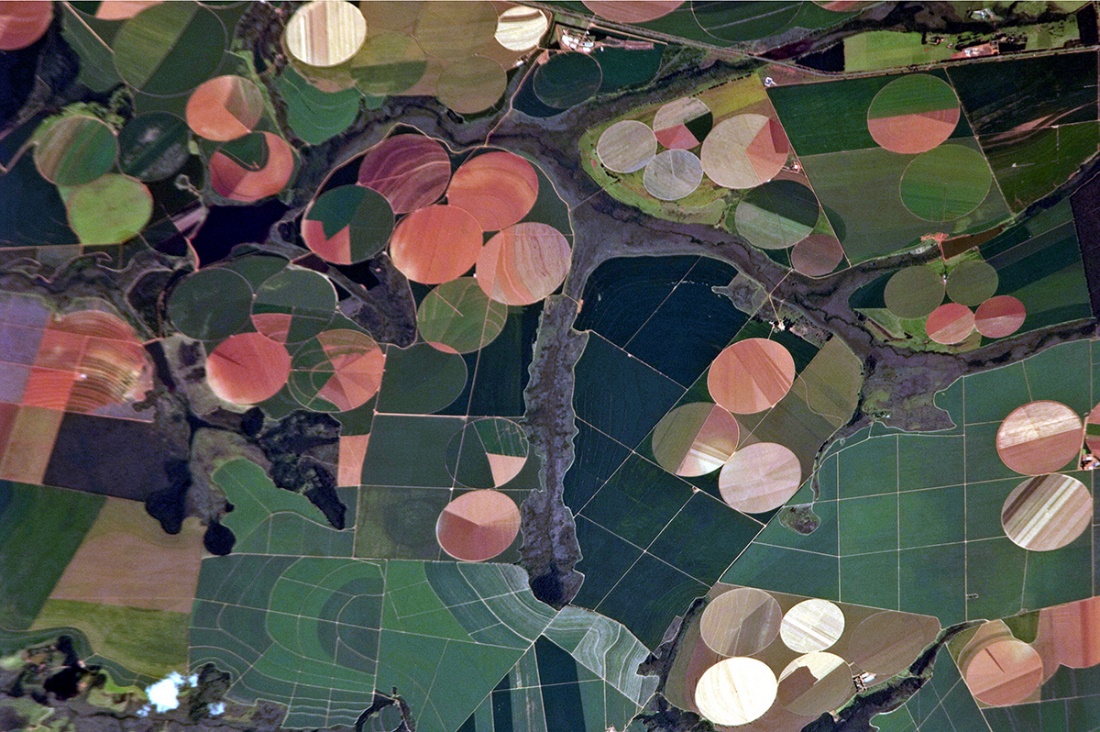
In the movie, "Interstellar," the physics was inventive, but carefully thought out while the environmental science was environmental ideology.

The environmental consequences of agriculture.  In the movie, “Interstellar,” the physics may have been inventive, but it was carefully thought out.  The environmental science, on the other hand, was poor.  There are many reasons Earth may one day no longer sustain us – ironically, agriculture, our primary way of sustaining human growth, is one of them.

Standard
Uncategorized

Horses and Insurgents

I came across this recent paper published in Nature Communications on the Cambaytheres, a group of mammals I have to confess I had not heard of before, but the article made me think about horses and insurgents.

In the paper, Kenneth Rose and his co-authors claim that 50 million-year-old fossils found in an old mine in Gujarat, India tell us that horses, rhinos, and tapirs, or the Perissodactyla, originated in India.  What’s interesting is that 50 million years ago, India was an island, adrift at sea, heading for a horrific, slow crash with Eurasia.

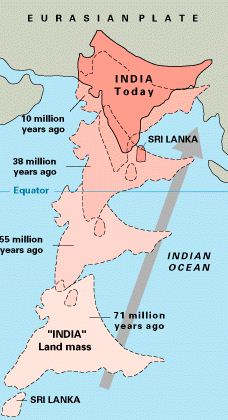
India adrift.   Cruising from the south after her split up with Africa and Australia and her abandonment of Madagascar, she crashed into Eurasia. The mountains to the north are the crumpled regions of the crash.  Part of her western region is known as Pakistan.

India adrift. Cruising from the south after her split up with Africa and Australia and her abandonment of Madagascar, she crashed into Eurasia. The mountains to the north are the crumpled regions of the crash. Part of her western region is known as Pakistan.

It’s hard to fathom – but India began as a massive chunk of land squeezed between Africa and Australia in the Southern Hemisphere a half a billion years ago.  She broke free and fled across the sea, leaving Madagascar behind but taking Sri Lanka with her until she crashed violently into Asia – the Himalayan mountain range is like massive, rumpled bumper of the crash.

When I close my eyes, I see India cruising at top speed across the ocean, breaking waves, leaving a huge wake, but, of course, the actual trip took a couple hundred million years, so I doubt any of the creatures on board noticed or felt even mildly seasick.

What Rose and his colleagues tell us is that some of the creatures on board were the evolutionary ancestors of the Perissodactyla.  The fossils they examined are bones of Cambaytherium species, mammals from the Indo-Pakistan region dating back to the Eocene, some 56 to 33 million years ago.  Since the Cambaytherium share a common ancestor with the Perissodactyla, and India was an island at the time, the evolutionary roots of horses, rhinos, and tapirs must be Indian.

It’s hard now, when looking at the horses in Central Park or the police horses in Times Square, to not want to go up and ask them what it’s like to be of Indian ancestry – I always felt a kinship with them, as I do with all creatures, but now I feel a little closer.  My bacterial cousins go back 3.5 billion years, but my horse cousins go back a mere 50 million years – that practically makes them siblings rather than cousins.

I’ve been to Gujarat.  My student, Meha Jain, worked in Gujarat, so I went to see her doing her dissertation work.  I had a fantastic time during my visit.  I didn’t have time to go see the last remaining population of the endangered Asiatic Lion and the endangered Asiatic Wild Ass that reside in reserves in Gujarat.  When I travel, I try to visit nature, but there wasn’t time and the reserves were far away.  The rural farmscape, however, though devoid of natural habitat, had a beauty of its own.

Like many, of course, I knew Gujarat for the 2002 massacre of hundreds of Muslims and the displacement of thousands more.  A center for Hindu nationalism, a violent history, and the complicity of its Governor, Narendra Modi, in the violence, seemed contrary to its warm and gracious people and its intricate culture.  In spite of Modi’s dubious past, he was immensely popular in Gujarat, his portrait was everywhere, and today, he is India’s Prime Minister.  When he visited here in late September, he was greeted as if he were some sort of hero – at Madison Square Garden, an audience of 19,000 cheered.

When I think of Gujarat, I think of India and about its extraordinary geological and biological history that generated amazing natural wealth – some of the most unique and diverse flora and fauna in the world are found in India.  When we, by which I mean our species, arrived in India, out of Africa and on our way to South East Asia and eventually to Australia and New Zealand, many of us must have stayed in places that must have seemed like the fictional Shangri La.

Out of Africa and into India happened only 50 to 70 thousand years ago, yet, in that short time, and particularly in the last 100 years of colonialism and postcolonialism, we have spent down the natural wealth of the region.  With the spending down of that natural capital, as economists call it, to make built capital, another economics term, we now have farms that barely support their people and cities that lack the resources to provide the kind of infrastructure necessary to make urban environments work well for many.  Some 270 million people live in poverty in India – how did that happen?

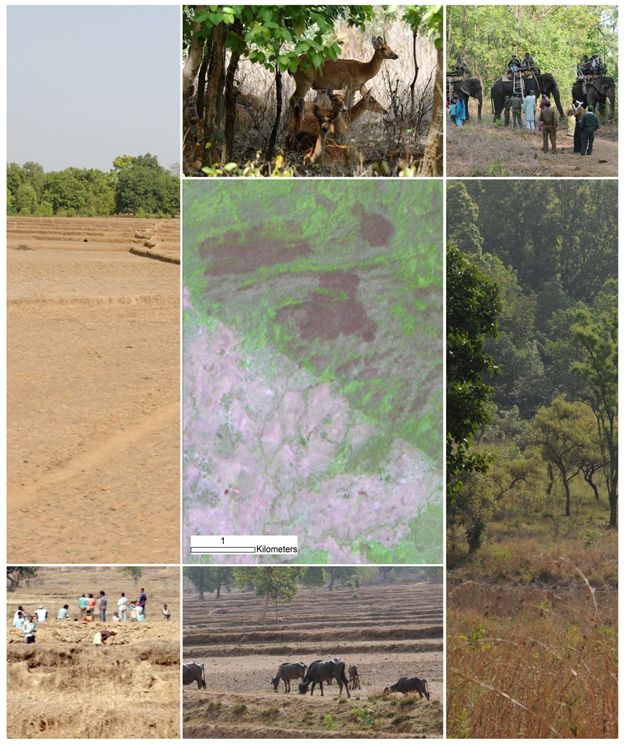
Then (50 thousand years ago) and now.  The center shows a satellite image of Khana National Park (green area above the diagonal which is the park boundary) vs. agricultural transformation (whitish areas left of the boundary).   Pictures on top and left are from the park, while pictures on the bottom and right are of the surrounding landscape.  I took all these pictures on a single day in August, 2009 and the figure was published in an article. Naeem, S. and R. DeFries. 2009. La conservation des espèces, clé d'une adaptation climatique durable., Institut du développement durable et des relations internationals. Sciences Po., Paris, France.

Then (50 thousand years ago) and now. The center shows a satellite image of Khana National Park (green area above the diagonal which is the park boundary) vs. agricultural transformation (whitish areas left of the boundary). Pictures on top and left are from the park, while pictures on the bottom and right are of the surrounding landscape. I took all these pictures on a single day in August, 2009 and the figure was published in an article.
Naeem, S. and R. DeFries. 2009. La conservation des espèces, clé d’une adaptation climatique durable., Institut du développement durable et des relations internationals. Sciences Po., Paris, France.

I’m not a political scientist and have no particular authority on social or humanist matters, but it seems to me that the end result of the loss of nature’s capital is a rise in insurgency.  In the general region, Sunni insurgents attack Iran, the Jaish-e-Mohammed, Harakat ul-Mujahidin and Lashkar-e Tayyiba fighters fight with the Pakistani government, the Taliban attack Afghanis, Sikh insurgents in Punjab attack their fellow citizens as do Naxalite Maoists in Eastern India.  In the grand scheme of things, these violent conflicts are small compared to the hundreds of millions who reside peacefully in the region, but that is cold comfort to the innocent killed or injured in the struggles.  Worse, insurgency is a source of omnipresent fear and often an obstacle to tackling other issues, such as poverty, income inequality, and environmental degradation – the very things that breed insurgency.  In the US, for example, we invest less and less in the environment, but out of fear and distraction, we have spent 2 – 5 trillion dollars on fighting insurgents since 9/11.

I know my thinking is often pretty circuitous, to say the least, but that’s what the paper by Rose and his colleagues does for me.  Now, when I see horses, I think of India and its extraordinary biogeographical history and how, in the geological blink of an eye, we transformed the very places within which we and biological diversity prospered, to landscapes that, in the absence of any ecologically sensible stewardship, lead to poverty, inequality, and the autocatalysis of insurgency.

Standard
Uncategorized

We’re here after all, thank God.

The Big Bang – it happened, thank God.

I was worried, as I am from time to time, that we’re not here in spite of all appearances – all this extraordinary diversity of life on Earth, the sun, the moon, us – none of this really exists.  Thanks to Herranen, Markkanen, Nurmi and Rajantie, in their piece just published in Physical Review Letters, I feel reassured, at least for the moment.

Herranen and co-authors theorize that it does not take any new kind of theory to explain why the universe didn’t collapse some 13.8 billion years when the Higgs boson appeared.

Phew!

Remember the big splash the Higgs boson made in the summer of 2012?  It’s is one of those subatomic particles that the Standard Model of physics suggests should exist and, in 2012, after some $13.25 billion dollars of research, a bunch of scientists confirmed that indeed the thing exists.  Not bad – about a dollar a year, every year, since time immemorial.

The Higgs boson was given the popular name, the God Particle because it is the particle that gave mass to the other subatomic particles.  Without it, we’d be massless.  The problem is that cosmologists working at a different facility, one called the Background Imaging of Cosmic Extragalactic Polarization 2, or BICEP2, provided data that, in combination with what we learned from the Large Hadron Collider about the Higgs boson, suggested that shortly after the Big Bang (like less than a second!), the universe should have collapsed.

Proof of the Higgs boson.

In other words, the God Particle was a capricious little thing that, though it made the universe interesting by giving its particles mass, in the act of so doing, it destabilized the universe.  Our baby universe should have collapsed back into itself.  The Big Unbang should have followed the Big Bang.

Thank God it didn’t.

The fact that the universe did not collapse must, for some, confirm the existence of God, and the fact that the God Particle is not a capricious little thing that could have destroyed the baby universe, is a great relief to them.  It’s a bit convoluted, this thinking, but it goes something like this.  Scientific Creationists believe in the exceptionalism of our species – God loved us most out of the all the millions of species ever created.  Like any group of people that think themselves exceptional, they are terrified by any idea that may prove them not to be exceptional.  Thus, to be related to and on equal footing with birds, morpho butterflies, monkeys, and whales is a terrifying thought.

It’s hard, when you have lots of siblings and you thought you were your parents’ favorite, to discover that you’re not.  Creationists are so mad at this fact of unexceptionalism revealed by evolutionary biologists, that they go through incredible lengths to try to dismiss evolution – but they never win this “debate” they invented.  This constant defeat is doubly frustrating to them, I’m sure because not only can they not win the very debate they invented, they must also accept that their parents love all 8.7 million of their children equally.

Personally, that’s a kind of love I find much more comforting than exceptionalism.  Parentally-invoked exceptionalism creates huge pressures on kids.  I speak from experience.

Since Scientific Creationism was struck down by evolution, creationists have been working to make the alternative view, known as Intelligent Design, scientifically prove human exceptionalism.  The basic idea is that if something in the long history of the universe should have snuffed us out and it didn’t, then there is nothing random or capricious about the universe – it’s all part of an intelligently designed plan.

For them, the fact that the God Particle did not destabilize the cosmos serves as further proof of Intelligent Design.  God made all the particles and forces to have just the right properties so that the universe did not collapse shortly after creation.  Then, 10 billion years later, starting with the primordial ooze on the baby Earth, birds, morpho butterflies, monkeys, whales, and some 8.7 million other species now exist.  They built a magnificent, robust, vibrant and beautiful biosphere, though it took a while – over 3.8 billion years.    God’s endgame was clearly to create an exceptional species that would appreciate His work.

To subscribe to Intelligent Design does mean having to give up Scientific Creationism and give up tilting at evolution, but perhaps this is a small price to pay to feel like God loves us most.

So, thank God for our investment in the Large Hadron Collider and BICEP2!  They proved the God Particle exists and the Big Unbang did not happen.

It is convenient, of course, from time to time, to come to the conclusion that what surrounds us isn’t real.  Maybe I have no committee meetings this week.  Maybe all those things I’m supposed to do, but haven’t gotten to, aren’t real.  Maybe these bills I have to pay are an illusion.

Alas, to put it simply, as Herranen and colleagues explained, though it is terrifying that “If H ≫ 109 GeV, the inflationary fluctuations of the effectively massless Higgs field immediately trigger a transition to the false vacuum as the probability density at the barrier scales as P ∼ expð−8π2Vmax=3H4Þ,” they found that “for a high inflationary scale H ≫ Λ¯ max ∼ 108 GeV the UV-induced (subhorizon) curvature corrections alter the SM Higgs effective potential significantly during inflation.”

OK, I’ll be honest.  I look at it this way – they say that the more you think you understand the Standard Model, the more you can be certain you don’t, so I’m proud to say I really don’t think I fully understand Herranen and Co., which means I get what they’re saying – the universe didn’t necessarily have to become unstable and collapse once the Higgs boson entered the scene.

So maybe God has been watching over us since the beginning and all this is real and I do have to go to meetings and I do have to make those deadlines and I do have to pay those bills.  It also should mean, for the Scientific Creationists and subscribers to Intelligent Design, we could very well be an exceptional species.  If you believe that, then we should be saving the living world that supports us, just as God would.

Wrecking the Biosphere – not what an exceptional species would do. Red represents fires we set.

Standard